
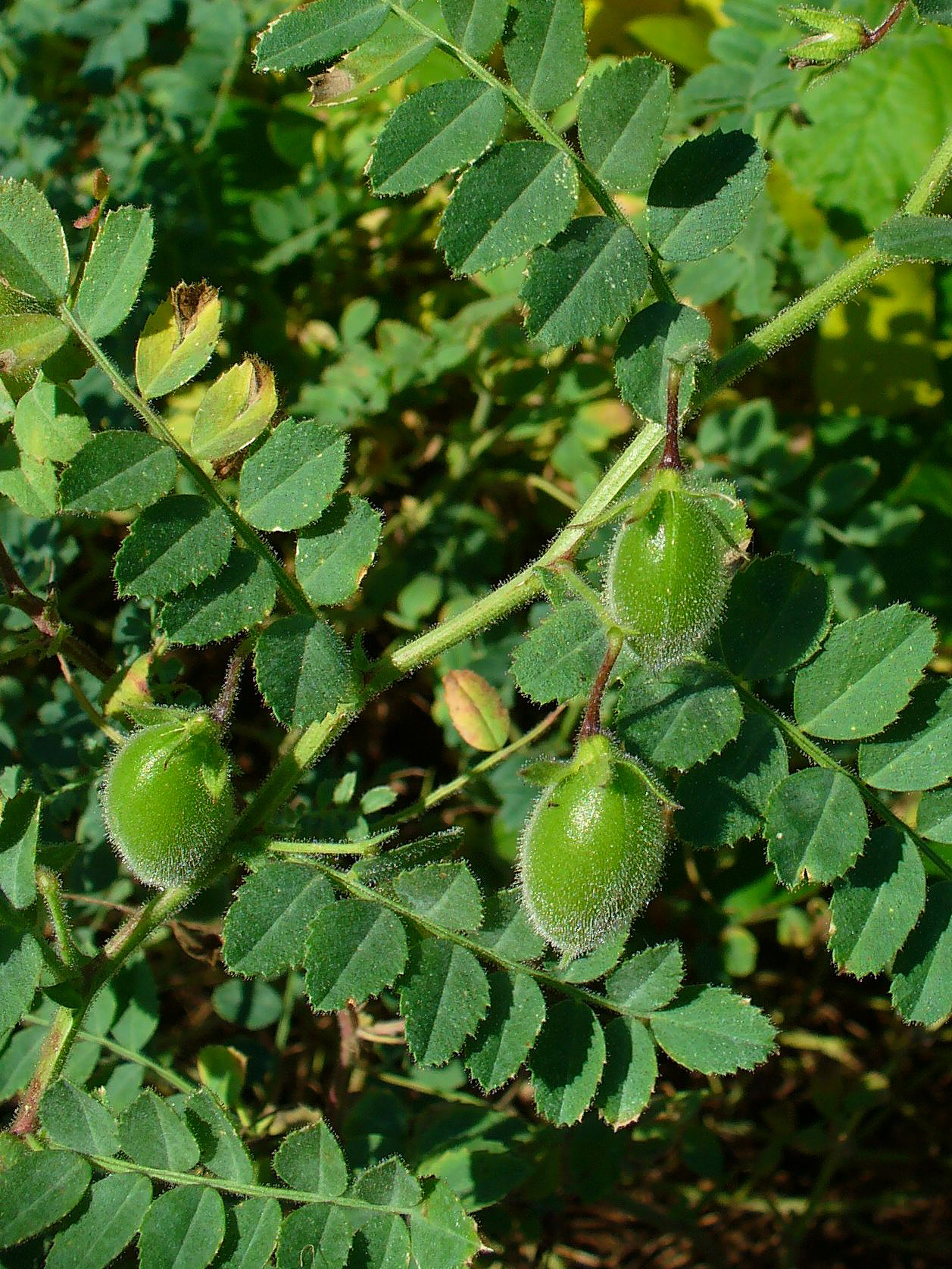
Chickpea
Cicer arietinum
Cool-season annual pulse (food legume) grown for dry edible seeds, eaten as the kabuli type (large cream/white seed; sold as garbanzo bean) or the desi type (smaller pigmented seed; often split into chana dal). Globally one of the most important pulses (~17 million metric tons produced annually) and well adapted to semi-arid Zones 4-9 with cool springs and warm, dry seed-fill. Performs best on deep, well-drained loam soils at pH 6.0-8.0 and tolerates a broad pH range (5.3-8.5). Typical season is 100-130 days; requires roughly 110-130 frost-free days.
Crop Snowflake Score
/acre
/acre
/acre
years
Overview
Chickpea (Cicer arietinum L.) is a self-pollinated cool-season grain legume in the Fabaceae. It is direct-seeded in spring once soil temperatures at seeding depth reach ~5°C (41°F) for desi types and ~10°C (50°F) for kabuli types; recommended seeding depth is 3.5-6 cm (1.5-2.5 in). Plant populations are commonly 4-5 plants/ft² (43-54 plants/m²) for kabuli and 5-6 plants/ft² for desi, drilled in 6-12 inch rows. Like other pulses, chickpea fixes atmospheric nitrogen in symbiosis with Mesorhizobium ciceri — inoculation with the specific rhizobial strain is essential at first cropping. Starter N is generally not recommended; phosphorus and potassium should match soil tests. Optimum daytime temperatures during vegetative growth are 21-29°C (70-85°F); flowering and pod-fill prefer mild conditions and adequate moisture (about 15-25 cm / 6-10 inches of growing-season precipitation suits the crop). Maturity is reached when ~90% of pods turn tan and seeds rattle; combining is done at 14-18% seed moisture and dried/stored at ≤14%. The crop's most important pathology is Ascochyta blight (Ascochyta rabiei), which can cause complete yield loss in wet years — variety resistance, certified disease-free seed, seed treatment, and timely foliar fungicides are the management package. Fusarium wilt, Sclerotinia, root rots, and pea aphid are additional pests. Common rotations are with cereals (wheat, barley) and oilseeds; chickpea should not follow pulses or canola within 3-4 years to manage disease. Typical rainfed yields in the northern Great Plains are 1,200-2,000 lb/acre, with irrigated and high-management fields exceeding 2,500 lb/acre.
Growing Season
- Plant
- Mid-spring once soils reach 5-10°C at seeding depth – Late spring (before late May in short-season regions)
- Harvest
- Late summer (≈100-130 days after seeding) – Early fall, at 14-18% seed moisture
- Frost-free days
- 110+
- GDD (base 50°F)
- 1,400 – 1,800
Yield
- Typical yield
- 1,500 lb/acre (dry seed, clean)
- Productive lifespan
- 1 years
- Years to full prod.
- 1
Market Fit
Active Regional Buyers
1 active buyer on record purchasing this crop.
Price Trend Stable/Up
3-year price trend recorded as "declining".
Supply Below Demand
Priced on national grain markets where supply is well established, leaving little regional headroom regardless of local channel strength (1 of 5 channels rate "strong").
Multiple Buyer Channels
3 of 5 documented market channels rate viable or better (wholesale, retail, direct_to_consumer). Multiple independent routes to market.
Value-Added Potential
1 viable direct-market channel (direct_to_consumer). Limited direct-market routes; value chiefly captured at wholesale.
Market Growth Projected
Mature grain market; growth over a 5-year horizon is expected to track population rather than outpace it.
Market Channels
Climate Fit
Hardiness Zone Match
Crop tolerates zones 4-9; region spans 5-6. Overlaps.
GDD Sufficient
Crop needs 1400 GDD (base 50F); region accumulates 2500+. Sufficient.
Precipitation Compatible
Crop needs ~12 in; region receives ~38 in/yr. Compatible, irrigation available as supplement.
Frost-Free Season OK
Crop needs 110 frost-free days; region provides ~180. Sufficient.
Chill Hours Met
Not applicable — annual crop has no winter chill requirement.
Climate Trend Favorable
Crop spans 6 hardiness zones (4-9). Wide adaptive range buffers against warming trend.
Fit by region
The farm matcher, run on each region's cited climate normals. Soil and site are not included here; add your own on the match page.
Limited by high-severity risks. 5 criteria evaluated; 80% cited.
Limited by high-severity risks. 5 criteria evaluated; 80% cited.
Limited by high-severity risks. 5 criteria evaluated; 80% cited.
Climate envelope & site
What the farm matcher compares your conditions against.
Climate envelope
- Hardiness zone
- n/a
- Frost-free season
- 110+ days
- Heat (GDD base 50°F)
- 1,400+
- Winter chill
- n/a
- Rainfall
- 23.6–70.9 in/yr
Below the minimum, irrigation is needed; above the maximum the crop fails.
- Soil pH target
- 6.0–8.0
Extension lime target; within 1.0 of it is correctable.
Site & structure
- Spring frost at bloom
- n/a
- Needs cold-air drainage
- n/a
- Shade tolerance
- none — full sun
- Mature height
- not yet recorded
- Rooting depth
- not yet recorded
- Wind exposure tolerance
- not yet recorded
- Workable slope
- not yet recorded
Height, rooting depth and shade tolerance are the inputs an alley or guild layout needs.
Soil Compatibility
Soil Texture
Drainage
Infrastructure Fit
Equipment Compatible
1 of 8 documented equipment items are crop-specific (13%) against a catalog median of 29%. Most needs are met by general row-crop or orchard equipment.
Storage Available
3 documented storage routes; at least one (Grain bin (on-farm)) is reachable with conventional on-farm or third-party facilities.
Irrigation Compatible
Requires ~12 in. Deliverable with conventional drip or overhead irrigation.
Field Layout Suitable
Grain crops need large contiguous acreage to be economic; the region's parcels are typically small and fragmented by topography.
Labor Availability
Labor requirement not recorded. Catalog 75th percentile is 250 hr/ac.
Processing Proximity
1 processor/cooperative buyer on record for this crop.
Equipment Requirements
planting
Seeded in narrow rows (6-12 in). Air drills and openers often need minor modification and adjustment to avoid cracking large-seeded kabuli seed and to meter it correctly.
Chickpea requires its specific inoculant (Mesorhizobium ciceri / M. mediterraneum), applied as granular in-furrow or as seed-applied liquid/powder; granular is preferred in dry or acidic seedbeds.
cultivation
Rolling levels the soil and presses down rocks for easier low harvest; complete immediately after seeding or after plants are well emerged but before the six-leaf stage. Avoid rolling during emergence.
spraying
Ascochyta management typically needs a fungicide at early bloom and subsequent applications at 10-14 day intervals through the season, so reliable, timely spraying capacity is essential.
harvesting
Because of indeterminate growth, most growers swath or chemically desiccate to even out dry-down before combining; seed crops should not be desiccated with glyphosate or saflufenacil.
Chickpea has a thin seed coat and a protruding beak that crack easily; run cylinder speeds as low as possible and use conveyor belts or keep augers full and slow to minimize seed damage.
post_harvest
Chickpea can be stored at about 15% moisture; minimize handling to reduce cracked/damaged seed, which is a significant dockage factor.
general
A tractor of appropriate size powers seeding, rolling, spraying and harvest-support operations; a shared fixed cost across the cropping enterprise.
Storage Requirements
Grain bin (on-farm)
Temperature
?–59°F
Max Storage
365 days
Long-term dry storage
Temperature
?–50°F
Max Storage
730 days
Commercial elevator silo
Financial Return
Revenue Above Average
Gross revenue not recorded for this crop in lake_erie. Cannot establish it exceeds the catalog median of $6,000.
Input Costs Acceptable
Input cost not recorded; not penalising. Catalog 75th percentile is $6,300/ac.
Payback Period OK
Reaches full production in 1 year. Acceptable payback.
Insurance Available
Federal crop insurance or an equivalent risk product is available.
Revenue Per Labor Hour
Cannot compute — net return not recorded. Catalog median is $13.16/hr.
Grants/Subsidies
No specialty-crop or cover-crop incentive program identified for this grain crop.
Economics Breakdown
| Avg Price/Unit | $17/$/cwt |
| Gross Revenue/Acre | — |
| Annual Operating Cost | —/acre |
| Establishment Cost | —/acre |
| Total Input Cost | —/acre |
| Net Return/Acre | — |
| Revenue/Labor Hour | — |
| Crop Insurance | Available |
| Subsidies | ARC-CO, PLC, Pulse Crops MAL/LDP |
Source: USDA NASS Agricultural Prices (Apr 2026): US all-chickpeas $16.70/cwt Mar 2026, down from $19.40/cwt Feb 2026 and $31.10/cwt Mar 2025 (sharply declining). Dryland yield potential 850-3,000 lb/ac (MSU Extension 'Growing Chickpea'). Per-acre cost structure pending a citable regional enterprise budget (NDSU 2026 regional budgets do not include a chickpea table). Large & small chickpeas are ARC/PLC covered commodities + eligible for 2026 Pulse Crops MAL/LDP (USDA FSA). Chickpea is a Northern Plains/PNW pulse not commercially grown in the Lake Erie region; US national price used as best-available reference. (2026)
Risk Profile
Manageable Pest/Disease
5 of 11 documented risks are high-severity (45%) against a catalog median of 36%. Above-median concentration of high-severity risk, demanding intensive management.
Market Diversified
3 viable market channels of 5 documented, plus 1 named buyer. Not dependent on a single outlet.
Low Establishment Risk
1 year to full production. Low establishment exposure.
Climate Resilient
Tolerates zones 4-9 (6 zones). Broad tolerance indicates resilience to seasonal variability.
Regulatory Burden Low
No crop-specific licensing or reporting regime beyond standard food-safety and pesticide rules.
Diversifies Portfolio
Adds a grain revenue stream distinct from the region's grape-dominated base.
Known Risks
disease
Foliar fungal disease that can cause complete crop loss even in fields with no prior history. Develops fastest in cool (59-77 F), wet conditions; spores travel for miles, so any field must be scouted.
Devastating fungal disease that can cause total crop loss; most severe in dense canopies where it develops in the interior and is hard to reach with fungicide. Develops in extended cool, wet weather.
Soilborne pathogens (numerous Pythium spp. and Rhizoctonia solani) cause poor emergence, seedling death and root rot. Large-seeded kabuli types are especially susceptible; damage worst in cool, wet soils.
Fungal disease that develops in extended cool, wet weather; generally only moderate impact on chickpea yield and rarely causes significant economic loss, but can appear alongside Botrytis.
pest
Several species cut and consume seedlings from the seedling to 6-8 leaf stage. Chickpea is more susceptible than small grains because cut plants do not regrow; severe infestations can destroy whole fields.
Larvae feed on germinating seed and seedlings, causing thin stands and bare patches; infestations persist for years because of the 3-4 year life cycle and are worse where pulses follow grasses or sod.
Generalist feeders; greatest risk is from the bud stage through early pod development when they consume flower buds and small pods, causing yield loss and delayed maturity. Populations build in hot, dry years.
weather
Chickpea has an indeterminate habit and keeps flowering and setting pods as long as moisture is available. Cool, wet late-season conditions greatly delay maturity and produce green seed; in wet years the crop may never fully mature.
Chickpea is injured by waterlogged soil relatively quickly compared with other broadleaf or cereal crops; poorly drained fields raise both injury and root-disease risk.
market
Chickpea is a high-risk/high-input specialty crop whose acreage and price fluctuate sharply. It cannot necessarily be delivered to a local elevator, so a buyer must be secured before planting.
Most chickpea is sold as human food where seed color and size drive marketability. Split, cracked, discolored or green (immature) seeds cause steep discounts or rejection; weathered seed from delayed harvest is downgraded.
Nutritional Yield
Macronutrients
| Nutrient | Per 100 g | Per acre |
|---|---|---|
| Calories | 378 kcal | 2,571,855 kcal |
| Protein | 20.5 g | 139,275 g |
| Total fat | 6 g | 41,095 g |
| Carbohydrates | 63 g | 428,302 g |
| Fiber | 12.2 g | 83,007 g |
| Sugar | 10.7 g | 72,801 g |
Key micronutrients
Uncertainty: Per-acre values are estimates that compound the yield range, edible-fraction assumption, and a single representative nutrient panel. Treat them as order-of-magnitude planning numbers, not nutritional advice. Confidence: high.
Ecosystem Services
Soil nitrogen
- Symbiotic nitrogen fixationhigh
As an inoculated grain legume, chickpea fixes a large share of its own nitrogen through symbiosis with Mesorhizobium, with studies indicating 50-90% of the nitrogen used during the season comes from fixation, reducing fertilizer N needs and crediting the following crop.
Applies when: well-inoculated stands on non-saline soilsEvidence: Extension guidance·Confidence: high
Pest suppression
- Rotational break that disrupts cereal pestsmoderate
As an annual legume in rotation, chickpea disrupts cereal pest and disease life cycles and allows alternative herbicides to clean up grassy weeds, improving the following cereal crop.
Applies when: grown in rotation with cerealsEvidence: Extension guidance·Confidence: high
Nutrient cycling
- Soil nitrogen contribution to rotationmoderate
Beyond meeting its own needs, the legume increases the soil nitrogen supply available to subsequent crops, part of why cereal yields rise after pulses.
Applies when: followed by a nitrogen-demanding cropEvidence: Extension guidance·Confidence: high
Soil health
- Deep rooting and subsoil moisture uselow
Chickpea has a moderately deep rooting system (similar to spring wheat) effective at extracting subsoil moisture, diversifying rooting depth in a rotation.
Applies when: deep soils with stored subsoil moistureEvidence: Extension guidance·Confidence: medium
Biodiversity
- Cropping-system diversificationlow
Adding a pulse broadens crop diversity in cereal-dominated rotations, supporting more varied soil biology and breaking pest and weed cycles.
Applies when: added to a low-diversity rotationEvidence: Extension guidance·Confidence: medium
Cultivars
Named varieties and what the sources say sets each apart. A cultivar-specific zone, chill or maturity figure overrides the species value above.
No cultivars recorded yet for this crop.
Grows With / Avoid Near
Documented interactions with other catalog crops — shared pests, allelopathy, rotation effects, alley and understory pairings — for companion, guild and rotation planning. Plan a combination with Chickpea →
Avoid near, or plan around (2)
Grows with (2)
Direction matters: a rotation benefit of A before B says nothing about B before A. Interactions are documented pairs only; absence is a research gap, not a clean bill.
Nearby Buyers
Data Sources
Every data point on this page is traceable to its source. Below you'll find the complete provenance trail — which sources were used, when data was last verified, and a full change history.
Primary sources: USDA PLANTS (CIAR5); NDSU Extension — Growing Chickpea in North Dakota (A1236, Rev. April 2020); Government of Saskatchewan — Chickpea Adaptation, Varieties & Seeding Considerations; FAOSTAT 2018-2024 global production figures. Image: Wikimedia Commons (H. Zell, CC BY-SA 3.0). Cited in source_citations for downstream UI source-link icons.
Economics data year: 2026 · Basis: lake erie View economics source →
46 tracked changes across 10 data categories