
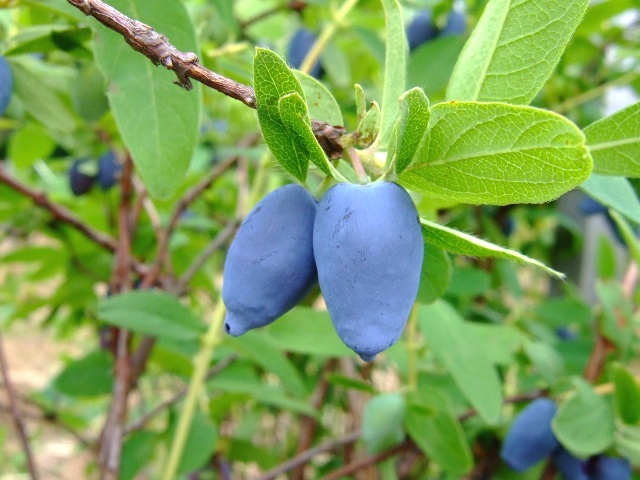
Honeyberry (Lonicera caerulea), also known as haskap, is a cold-hardy perennial shrub producing early-season oval blue berries with flavor blending blueberry, blackberry, and cherry notes. Suitable for Zones 2-8with late-blooming varieties; resilient, low-maintenance, and early ripening before strawberries.
Crop Snowflake Score
/acre
/acre
/acre
years
Overview
Growing Season
- Plant
- Spring or Fall – Spring or Fall
- Harvest
- Mid-June to early July – Mid-June to early July
Yield
- Typical yield
- 3,000 lbs/acre
- Productive lifespan
- 50 years
- Years to full prod.
- 5
- Labor
- 2300 hrs/acre
Market Fit
Active Regional Buyers
No buyer on record for this crop in the catalog's buyer network.
Price Trend Stable/Up
3-year price trend recorded as "increasing".
Supply Below Demand
2 of 5 documented channels rate viability "strong". Sold into regional rather than national markets, fruit supply here generally trails that demand.
Multiple Buyer Channels
3 of 5 documented market channels rate viable or better (direct_to_consumer, farmers_market, restaurant). Multiple independent routes to market.
Value-Added Potential
3 viable direct-market channels (direct_to_consumer, farmers_market, restaurant). Supports value-added and margin capture beyond wholesale.
Market Growth Projected
Specialty fruit segment; consumer demand for regionally grown specialty produce has been expanding.
Market Channels
Climate Fit
Hardiness Zone Match
Crop tolerates zones 2-8; region spans 5-6. Overlaps.
GDD Sufficient
Crop GDD minimum not recorded. Region accumulates 2500+ GDD (base 50F), sufficient for most temperate crops.
Precipitation Compatible
Crop water requirement not recorded. Region is humid continental with reliable growing-season rainfall; irrigation available as supplement.
Frost-Free Season OK
Crop frost-free requirement not recorded. Region provides ~180 days.
Chill Hours Met
Perennial. Region's zone 5-6 winters deliver well over 1,000 chill hours, ample for temperate perennials.
Climate Trend Favorable
Crop spans 7 hardiness zones (2-8). Wide adaptive range buffers against warming trend.
Fit by region
The farm matcher, run on each region's cited climate normals. Soil and site are not included here; add your own on the match page.
No limiting condition found. 6 criteria evaluated, 4 not yet researched; 50% cited.
No limiting condition found. 6 criteria evaluated, 4 not yet researched; 50% cited.
No limiting condition found. 6 criteria evaluated, 4 not yet researched; 50% cited.
Climate envelope & site
What the farm matcher compares your conditions against.
Climate envelope
- Hardiness zone
- 2–8
- Frost-free season
- not yet recorded
- Heat (GDD base 50°F)
- not yet recorded
- Winter chill
- 400–1,000 hours
- Rainfall
- not yet recorded
- Soil pH target
- 5.0–7.0
Extension lime target; within 1.0 of it is correctable.
Site & structure
- Spring frost at bloom
- low sensitivity
- Needs cold-air drainage
- not yet recorded
- Shade tolerance
- none — full sun
- Mature height
- not yet recorded
- Rooting depth
- not yet recorded
- Wind exposure tolerance
- not yet recorded
- Workable slope
- not yet recorded
Height, rooting depth and shade tolerance are the inputs an alley or guild layout needs.
Soil Compatibility
Soil Texture
Drainage
Infrastructure Fit
Equipment Compatible
2 of 7 documented equipment items are crop-specific (29%) against a catalog median of 29%. Most needs are met by general row-crop or orchard equipment.
Storage Available
3 documented storage routes; at least one (Fresh cold storage) is reachable with conventional on-farm or third-party facilities.
Irrigation Compatible
Water requirement not recorded; standard drip or overhead irrigation assumed adequate.
Field Layout Suitable
Suited to the small-to-mid-size fragmented parcels typical of the region.
Labor Availability
2300 labor hr/ac vs catalog 75th percentile 250 hr/ac. Labor-intensive — competes for scarce seasonal labor.
Processing Proximity
No processing or cooperative buyer on record for this crop; product would need to travel or be sold fresh.
Equipment Requirements
planting
General purpose tractor for site prep, mowing, and mulch application. Shared equipment across small fruit operations.
PTO-driven auger for digging planting holes. Speeds establishment for plantings over 100 bushes.
irrigation
Per-acre cost. Essential for establishment and during heat stress events. Honeyberries prefer consistent moisture.
harvesting
Per-acre cost for 1/2-inch mesh netting with support structure. Absolutely essential — birds will take entire crop without it.
Electric handheld shaker with long fingers for vibrating branches. Can harvest a bush in under 1 minute. Cost-effective for plantings over 200 bushes.
Shallow harvest trays to avoid crushing soft berries. Tarps placed under bushes when using shaker harvest method.
post_harvest
Honeyberries are very soft and perishable. Must be cooled to 32-34°F within hours of harvest. Essential for any commercial operation.
Storage Requirements
Fresh cold storage
Temperature
32–34°F
Humidity
90–95%
Max Storage
10 days
Modified atmosphere packaging (MAP)
Temperature
32–34°F
Humidity
90–95%
Max Storage
21 days
Frozen (IQF)
Temperature
-10–0°F
Max Storage
730 days
Financial Return
Revenue Above Average
Gross revenue $22,000/ac vs catalog median $6,000/ac. Above median.
Input Costs Acceptable
Input cost not recorded; not penalising. Catalog 75th percentile is $6,300/ac.
Payback Period OK
Reaches full production in 5 years. Long establishment — capital tied up 5 years before full return.
Insurance Available
No federal crop insurance recorded for this crop; risk sits with the grower.
Revenue Per Labor Hour
Net return per labor hour $1.96 ($4,500/ac over 2300 hr/ac) vs catalog median $13.16. Below median.
Grants/Subsidies
Fruit crops are eligible under the USDA Specialty Crop Block Grant Program.
Economics Breakdown
| Avg Price/Unit | $10/lb |
| Gross Revenue/Acre | $22,000 |
| Annual Operating Cost | —/acre |
| Establishment Cost | —/acre |
| Total Input Cost | —/acre |
| Net Return/Acre | $4,500 |
| Revenue/Labor Hour | — |
| Crop Insurance | Not available |
Source: Montana State University WARC Haskap Labor Estimates; HoneyberryUSA (Bagley, MN) retail pricing (2025)
Risk Profile
Manageable Pest/Disease
1 of 7 documented risks are high-severity (14%) against a catalog median of 36%. Risk load is manageable by conventional IPM.
Market Diversified
3 viable market channels of 5 documented. Not dependent on a single outlet.
Low Establishment Risk
5 years to full production. Multi-year capital commitment before first full return.
Climate Resilient
Tolerates zones 2-8 (7 zones). Broad tolerance indicates resilience to seasonal variability.
Regulatory Burden Low
No crop-specific licensing or reporting regime beyond standard food-safety and pesticide rules.
Diversifies Portfolio
Adds a fruit revenue stream distinct from the region's grape-dominated base.
Known Risks
disease
Fungal disease that typically appears after harvest in mid to late summer, causing white powdery coating on leaves with brown patches. Usually cosmetic and does not significantly impact fruit yield.
pest
Honeyberries ripen 2-3 weeks before strawberries, making them the first available fruit for birds. Without protection, birds can consume the entire crop within days.
Occasional aphid infestations on new growth tips. Generally minor and self-limiting in healthy plantings with good beneficial insect populations.
Caterpillars that roll and feed within leaves, primarily attacking growing tips. Damage is usually cosmetic and does not affect fruit production significantly.
climate
Honeyberries are adapted to cool climates and can suffer leaf scorch and reduced fruit quality during extended heat above 90°F. The growing region summer heat waves can stress plants.
Honeyberries bloom very early (often March-April in the growing region). While flowers can tolerate temperatures down to 20°F, severe late frosts during full bloom can reduce fruit set.
market
Honeyberries are still relatively unknown to most American consumers. Direct marketing requires significant consumer education about the fruit.
Nutritional Yield
Nutrition data pending.
Research agents will profile Honeyberry against USDA FoodData Central on the next maintenance pass. Per-acre nutritional yield will appear here once the per-100g panel is recorded.
Ecosystem Services
Ecosystem service data pending.
The next research-agent rotation will document this crop's contributions to pollinator support, soil health, water quality, biodiversity, and carbon sequestration.
Cultivars
Named varieties and what the sources say sets each apart. A cultivar-specific zone, chill or maturity figure overrides the species value above.
Grows With / Avoid Near
Documented interactions with other catalog crops — shared pests, allelopathy, rotation effects, alley and understory pairings — for companion, guild and rotation planning. Plan a combination with Honeyberry →
Grows with (1)
Direction matters: a rotation benefit of A before B says nothing about B before A. Interactions are documented pairs only; absence is a research gap, not a clean bill.
Nearby Buyers
Data Sources
Every data point on this page is traceable to its source. Below you'll find the complete provenance trail — which sources were used, when data was last verified, and a full change history.
Primary sources: Data sourced from Cornell Cooperative Extension, Penn State Extension, USDA resources, and regional research.
Economics data year: 2025 · Basis: lake erie View economics source →
70 tracked changes across 9 data categories