
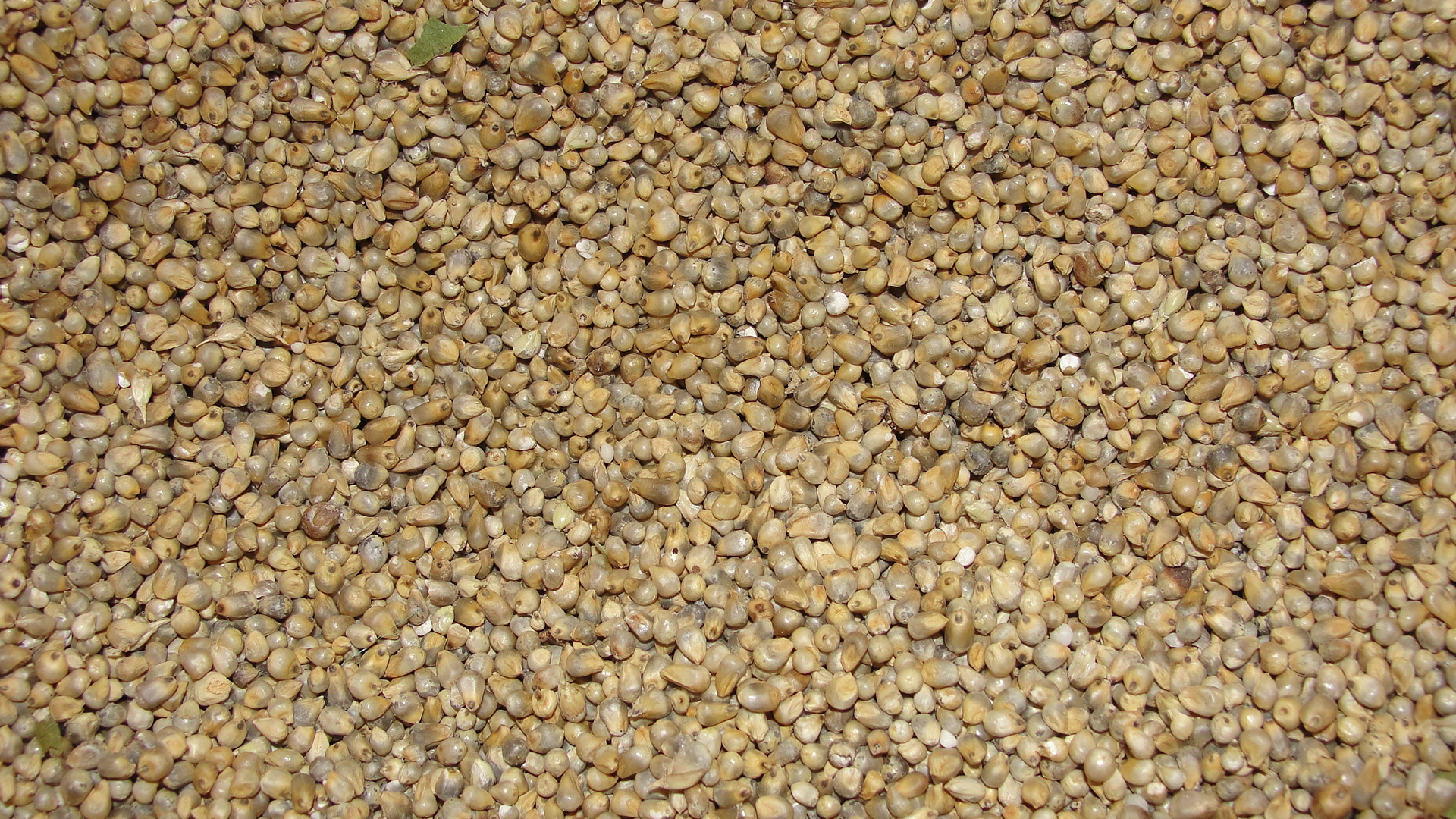
Pearl Millet
Pennisetum glaucum
Warm-season annual C4 cereal grain grown for human food, feed grain, forage, and cover. The most widely cultivated millet worldwide and a staple in arid regions of sub-Saharan Africa and South Asia, pearl millet has gained interest in temperate dryland systems as a drought- and heat-tolerant alternative grain. Best adapted to Zones 5-11 wherever frost-free seasons exceed about 90-110 days. Highly tolerant of sandy soils, low fertility, and pH from 5.5 to 8.0, performing best at pH 6.0-7.0. Grain yields of 60-80 bu/acre are achievable under good management; forage yields of 4-8 tons dry matter/acre are typical.
Crop Snowflake Score
Overview
Pearl millet (Pennisetum glaucum (L.) R. Br.; syn. Cenchrus americanus) is a warm-season C4 annual grass in the Poaceae. It is planted after frost risk has passed and soil temperatures at the 2-inch depth reach at least 65-70°F (18-21°C); germination is best at 75-90°F. Grain types are typically drilled at 4-5 lb seed/acre in 7-30 inch rows; forage types are seeded at 15-25 lb/acre. The crop has a deep, fibrous root system enabling exploitation of subsoil moisture and giving exceptional short-duration drought tolerance — yields are commonly higher than sorghum or corn in the most marginal moisture environments. Nitrogen is the main yield driver (typically 60-100 lb N/acre for grain; split applications increase efficiency); phosphorus and potassium are matched to soil tests. Pearl millet is largely free of the major corn pests (rootworm, European corn borer) and is non-host for soybean cyst nematode, making it a valuable rotation crop. Major diseases include downy mildew (Sclerospora graminicola), rust, and Pyricularia (leaf spot/blast); modern hybrids carry resistance. Grain harvest occurs ≈80-100 days after planting when seed moisture reaches 18-22%; grain is dried to 12-13% for storage. The whole grain is gluten-free, naturally high in iron, zinc, and protein (~11-12%), and is the basis of biofortified varieties developed by ICRISAT and HarvestPlus. Forage and dual-purpose hybrids are widely used in the US Southeast and Great Plains for summer grazing, hay, and silage; pearl millet does not accumulate the prussic acid that sorghum and sudangrass do, making it safer for ruminants.
Growing Season
- Plant
- Late spring through early summer once soil temperatures exceed 65-70°F – Mid-summer (allow ≈90-110 days to maturity before first frost)
- Harvest
- Late summer to early fall (≈80-100 days after planting at 18-22% seed moisture) – Mid fall
- Frost-free days
- 90+
- GDD (base 50°F)
- 1,600 – 2,000
Yield
- Typical yield
- 70 bu/acre (grain; ≈56 lb/bu)
- Productive lifespan
- 1 years
- Years to full prod.
- 1
Market Fit
Active Regional Buyers
No buyer on record for this crop in the catalog's buyer network.
Price Trend Stable/Up
3-year price trend not recorded for this crop.
Supply Below Demand
Priced on national grain markets where supply is well established, leaving little regional headroom regardless of local channel strength (0 of 4 channels rate "strong").
Multiple Buyer Channels
0 of 4 documented market channels rate viable or better (none). Thin — dependent on few outlets.
Value-Added Potential
0 viable direct-market channels. Limited direct-market routes; value chiefly captured at wholesale.
Market Growth Projected
Mature grain market; growth over a 5-year horizon is expected to track population rather than outpace it.
Market Channels
Climate Fit
Hardiness Zone Match
Crop tolerates zones 5-11; region spans 5-6. Overlaps.
GDD Sufficient
Crop needs 1600 GDD (base 50F); region accumulates 2500+. Sufficient.
Precipitation Compatible
Crop needs ~14 in; region receives ~38 in/yr. Compatible, irrigation available as supplement.
Frost-Free Season OK
Crop needs 90 frost-free days; region provides ~180. Sufficient.
Chill Hours Met
Not applicable — annual crop has no winter chill requirement.
Climate Trend Favorable
Crop spans 7 hardiness zones (5-11). Wide adaptive range buffers against warming trend.
Fit by region
The farm matcher, run on each region's cited climate normals. Soil and site are not included here; add your own on the match page.
No limiting condition found. 5 criteria evaluated, 1 not yet researched; 50% cited.
No limiting condition found. 5 criteria evaluated, 1 not yet researched; 50% cited.
No limiting condition found. 5 criteria evaluated, 1 not yet researched; 50% cited.
Climate envelope & site
What the farm matcher compares your conditions against.
Climate envelope
- Hardiness zone
- n/a
- Frost-free season
- 90+ days
- Heat (GDD base 50°F)
- 1,600+
- Winter chill
- n/a
- Rainfall
- 15.7–66.9 in/yr
Below the minimum, irrigation is needed; above the maximum the crop fails.
- Soil pH target
- 5.5–8.0
Extension lime target; within 1.0 of it is correctable.
Site & structure
- Spring frost at bloom
- n/a
- Needs cold-air drainage
- n/a
- Shade tolerance
- none — full sun
- Mature height
- not yet recorded
- Rooting depth
- not yet recorded
- Wind exposure tolerance
- not yet recorded
- Workable slope
- not yet recorded
Height, rooting depth and shade tolerance are the inputs an alley or guild layout needs.
Soil Compatibility
Soil Texture
Drainage
Infrastructure Fit
Equipment Compatible
2 of 7 documented equipment items are crop-specific (29%) against a catalog median of 29%. Most needs are met by general row-crop or orchard equipment.
Storage Available
2 documented storage routes; at least one (Grain bin (on-farm)) is reachable with conventional on-farm or third-party facilities.
Irrigation Compatible
Requires ~14 in. Deliverable with conventional drip or overhead irrigation.
Field Layout Suitable
Grain crops need large contiguous acreage to be economic; the region's parcels are typically small and fragmented by topography.
Labor Availability
Labor requirement not recorded. Catalog 75th percentile is 250 hr/ac.
Processing Proximity
No processing or cooperative buyer on record for this crop; product would need to travel or be sold fresh.
Equipment Requirements
planting
Sown at only 2-5 lb/acre and 1/2 to 3/4 inch deep; use precision or air/vacuum planters or a drill that can meter the small seed and place it shallow with firm soil on top.
cultivation
Row spacings of 14-30 in. (about 21 in. optimal) allow cultivation for weed control; canopy closure then shades out late weeds.
spraying
Needed for preventive chinch-bug control (penetrating sprays 14-21 days after emergence before canopy closure) and for 2,4-D on broadleaf weeds.
harvesting
Grain does not separate easily from the head, so careful combine adjustment is needed: roughly 700 rpm cylinder, 5/16 in. concave, 1/2 in. chaffer, 3/16 in. sieve and 700 rpm fan, re-checked through the day as seed moisture changes.
A desiccant is used to dry stems and leaves before harvest to improve combining efficiency in this leafy, slow-drying crop.
post_harvest
Harvested below 15% moisture but must be dried to 10-12% to prevent storage molds; the very small seed and tight pore spacing make drying slow, needing ~110-120 F air at adequate airflow.
general
A tractor of appropriate size powers seedbed prep, planting, spraying and harvest-support operations; a shared fixed cost across the cropping enterprise.
Storage Requirements
Grain bin (on-farm)
Ambient dry storage (grain)
Financial Return
Revenue Above Average
Gross revenue not recorded for this crop in lake_erie. Cannot establish it exceeds the catalog median of $6,000.
Input Costs Acceptable
Input cost not recorded; not penalising. Catalog 75th percentile is $6,300/ac.
Payback Period OK
Reaches full production in 1 year. Acceptable payback.
Insurance Available
No federal crop insurance recorded for this crop; risk sits with the grower.
Revenue Per Labor Hour
Cannot compute — net return not recorded. Catalog median is $13.16/hr.
Grants/Subsidies
Commonly funded as a cover crop under NRCS EQIP/CSP practice payments.
Risk Profile
Manageable Pest/Disease
2 of 10 documented risks are high-severity (20%) against a catalog median of 36%. Risk load is manageable by conventional IPM.
Market Diversified
0 viable market channels of 4 documented. Concentrated — losing one outlet would strand the crop.
Low Establishment Risk
1 year to full production. Low establishment exposure.
Climate Resilient
Tolerates zones 5-11 (7 zones). Broad tolerance indicates resilience to seasonal variability.
Regulatory Burden Low
No crop-specific licensing or reporting regime beyond standard food-safety and pesticide rules.
Diversifies Portfolio
Adds a grain revenue stream distinct from the region's grape-dominated base.
Known Risks
disease
Leaf-spot diseases appear under warm, wet conditions but cause only minimal damage on adapted, resistant hybrids.
Can be a major late-season disease reducing yield and grain quality; pressure rises with later planting.
Pre-harvest grain molds develop when grain fill and maturation occur in wet or humid weather and worsen if harvest is delayed; they reduce grain quality.
weather
Pearl millet is a warm-season annual; planting before soil at 2-inch depth reaches about 70 F causes reduced emergence and heavier weed competition. It is a small seed sown shallow.
On soils prone to water-logging, pearl millet roots shallowly, producing low seed protein and poor yields.
pest
Birds readily strip seed from heads in the field; losses can be severe in small fields or when harvest is delayed, especially during fall migration.
The main insect pest of grain pearl millet; a heavy infestation can cause crop failure. Worst in hot, dry weather and in fields heavy with crabgrass or panicum; damages plants from seedling to soft-dough stage.
Caterpillars destroy and damage developing seed on the heads; economic loss occurs when 15% or more of grain heads are infested. Most active for plantings made in mid-summer.
Stink bugs feed on developing grain and cause small, shriveled seed; most active on heads of mid-summer plantings.
market
Pearl millet grain has no firmly established market in many regions, so prices vary with end-user value and a buyer should be secured before planting.
Nutritional Yield
Nutrition data pending.
Research agents will profile Pearl Millet against USDA FoodData Central on the next maintenance pass. Per-acre nutritional yield will appear here once the per-100g panel is recorded.
Ecosystem Services
Climate adaptation
- Exceptional drought tolerancehigh
Pearl millet is one of the most drought-resistant grains in commercial production, with a very deep root system and no sharply defined critical water-use period, withstanding dry spells that would cause failure in other summer grains.
Applies when: dryland and drought-prone productionEvidence: Extension guidance·Confidence: high
Pest suppression
- Nematode-suppressive rotation crophigh
Resistant grain hybrids carry good resistance to peanut and southern root-knot nematodes and to the sting nematode, so pearl millet can be used in rotation without building nematode problems for following crops such as peanut and cotton.
Applies when: using nematode-resistant grain hybridsEvidence: Extension guidance·Confidence: high
Soil health
- Deep rooting and residual-nutrient scavengingmoderate
Pearl millet is deep-rooted and can use residual nitrogen, phosphorus and potassium, often needing lower fertility inputs than other summer grains, which suits low-input systems and recycles leftover nutrients.
Applies when: deep, well-drained soils in low-input systemsEvidence: Extension guidance·Confidence: high
Erosion control
- Conservation-tillage suitabilitymoderate
Pearl millet can be successfully no-till or conservation-tillage planted and is desirable on highly erodible land or clayey soils, reducing soil erosion while improving stand establishment.
Applies when: no-till / conservation tillage on erodible landEvidence: Extension guidance·Confidence: high
Biodiversity
- Wildlife food and habitatmoderate
Pearl millet is an excellent crop for wildlife plantings, attracting quail, doves and songbirds, providing seed food and cover in agricultural landscapes.
Applies when: plantings or residual seed left for wildlifeEvidence: Extension guidance·Confidence: high
Cultivars
Named varieties and what the sources say sets each apart. A cultivar-specific zone, chill or maturity figure overrides the species value above.
No cultivars recorded yet for this crop.
Grows With / Avoid Near
Documented interactions with other catalog crops — shared pests, allelopathy, rotation effects, alley and understory pairings — for companion, guild and rotation planning. Plan a combination with Pearl Millet →
Avoid near, or plan around (1)
Grows with (1)
Direction matters: a rotation benefit of A before B says nothing about B before A. Interactions are documented pairs only; absence is a research gap, not a clean bill.
Nearby Buyers
Data Sources
Every data point on this page is traceable to its source. Below you'll find the complete provenance trail — which sources were used, when data was last verified, and a full change history.
Primary sources: USDA PLANTS (PEGL2); UGA Extension B1216 — Pearl Millet for Grain; UF/IFAS SS-AGR-337 (AG347) Pearl Millet Overview and Management; Kansas State University Pearl Millet Breeding Program (Hays); USDA NIFA project 1024048. Image: Wikimedia Commons (Thamizhpparithi Maari, CC BY-SA 3.0). Cited in source_citations for downstream UI source-link icons.
54 tracked changes across 8 data categories