
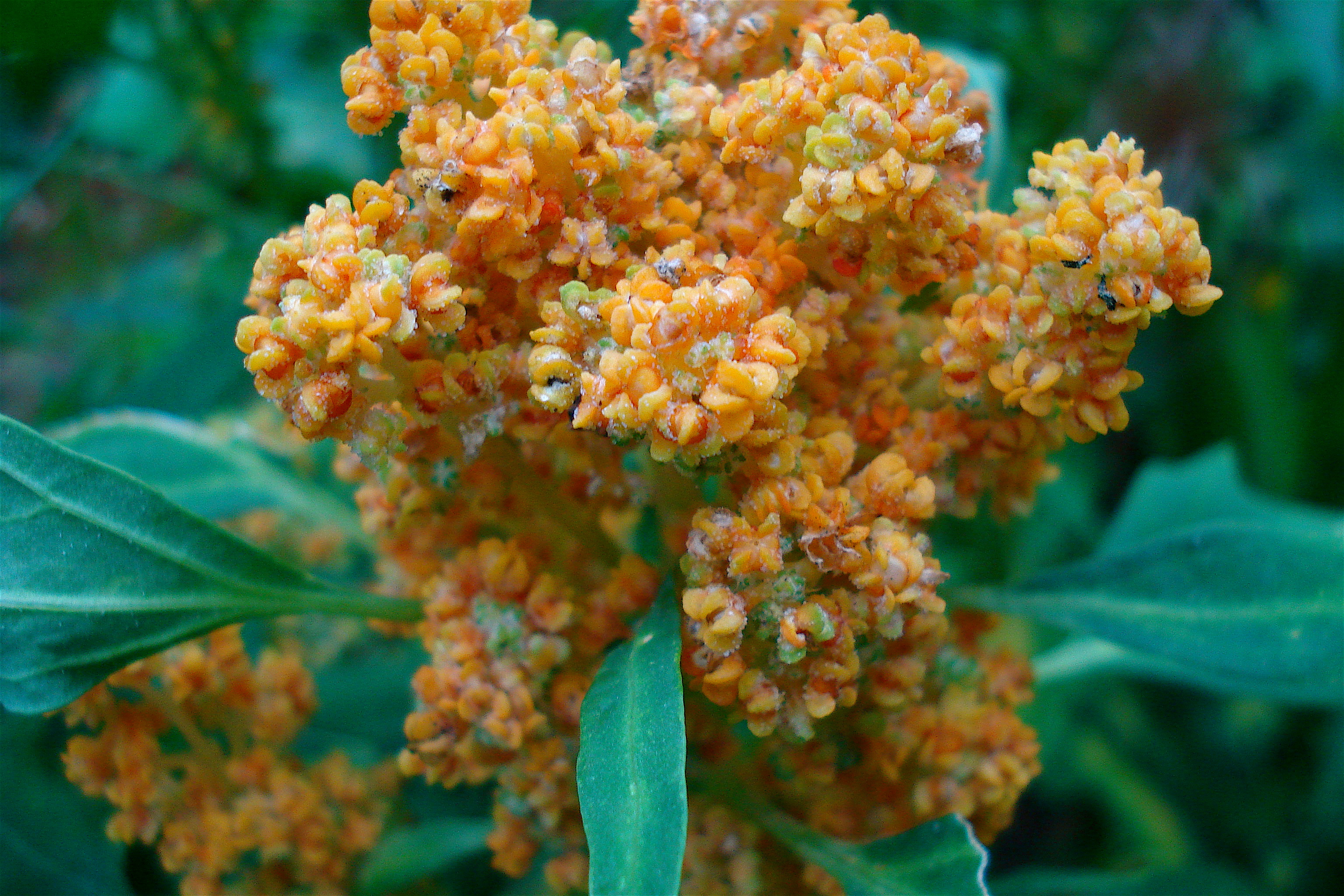
Quinoa (Chenopodium quinoa) is a cool-season annual pseudocereal grown for its small, protein-rich seeds. A broadleaf relative of spinach, beet, and lambsquarters, it grows 3-7 feet tall on a branched central stem topped with dense seed panicles that ripen green, red, pink, or purple. Adapted to cool temperate and high-elevation regions across roughly Zones 4-8, quinoa is direct-seeded in mid- to late spring once soils warm to about 50°F and matures in 90-120 days. It is highly drought- and salinity-tolerant, producing on as little as 10-20 inches of moisture, but is sensitive to sustained heat above about 90-95°F during flowering, which causes pollen sterility and poor seed set. It performs across a wide pH range (6.0-8.5) on well-drained soils.
Crop Snowflake Score
Overview
Quinoa (Chenopodium quinoa) is a cool-season annual pseudocereal in the family Amaranthaceae, grown for its small, protein-rich seeds. It is a broadleaf dicot — a relative of spinach, beet, and lambsquarters — that grows on a branched, often woody central stem 3-7 feet tall, topped by dense seed panicles that ripen green, red, pink, or purple. Quinoa is direct-seeded shallowly (about 0.5-1 inch) in mid- to late spring once soils warm to roughly 50°F, at low seeding rates of about 5-15 lb per acre; seedlings tolerate light frost. The crop matures in about 90-120 days. Quinoa is highly tolerant of drought and of saline and alkaline soils, performing on as little as 10-15 inches of moisture, but it is sensitive to sustained heat: temperatures above about 90-95°F during flowering cause pollen sterility and poor seed set, which is the principal limit on where it can be grown. Good drainage is essential, as waterlogging causes stunting and damping-off. Most cultivated quinoa seed carries bitter saponins in the seed coat that must be removed by washing or abrasion before consumption. Key production challenges include weed control during slow early growth, lodging of tall plants, downy mildew, and pre-harvest sprouting if mature seed is rained on; timely harvest once seed heads have dried is critical.
Growing Season
- Plant
- Mid to late spring, after soil warms to about 50°F – Early summer
- Harvest
- Late summer – Fall, once seed heads have dried
- Frost-free days
- 90+
Yield
- Typical yield
- 1,200 lbs/acre
- Productive lifespan
- 1 years
- Years to full prod.
- 1
Market Fit
Active Regional Buyers
No buyer on record for this crop in the catalog's buyer network.
Price Trend Stable/Up
3-year price trend not recorded for this crop.
Supply Below Demand
Priced on national grain markets where supply is well established, leaving little regional headroom regardless of local channel strength (0 of 5 channels rate "strong").
Multiple Buyer Channels
4 of 5 documented market channels rate viable or better (wholesale, direct_to_consumer, retail, farmers_market). Multiple independent routes to market.
Value-Added Potential
2 viable direct-market channels (direct_to_consumer, farmers_market). Supports value-added and margin capture beyond wholesale.
Market Growth Projected
Mature grain market; growth over a 5-year horizon is expected to track population rather than outpace it.
Market Channels
Climate Fit
Hardiness Zone Match
Crop tolerates zones 4-8; region spans 5-6. Overlaps.
GDD Sufficient
Crop GDD minimum not recorded. Region accumulates 2500+ GDD (base 50F), sufficient for most temperate crops.
Precipitation Compatible
Crop needs ~12 in; region receives ~38 in/yr. Compatible, irrigation available as supplement.
Frost-Free Season OK
Crop needs 90 frost-free days; region provides ~180. Sufficient.
Chill Hours Met
Not applicable — annual crop has no winter chill requirement.
Climate Trend Favorable
Crop spans 5 hardiness zones (4-8). Wide adaptive range buffers against warming trend.
Fit by region
The farm matcher, run on each region's cited climate normals. Soil and site are not included here; add your own on the match page.
No limiting condition found. 5 criteria evaluated, 1 not yet researched; 100% cited.
No limiting condition found. 5 criteria evaluated, 1 not yet researched; 100% cited.
No limiting condition found. 5 criteria evaluated, 1 not yet researched; 100% cited.
Climate envelope & site
What the farm matcher compares your conditions against.
Climate envelope
- Hardiness zone
- n/a
- Frost-free season
- 90+ days
- Heat (GDD base 50°F)
- not yet recorded
- Winter chill
- n/a
- Rainfall
- 19.7–102.4 in/yr
Below the minimum, irrigation is needed; above the maximum the crop fails.
- Soil pH target
- 6.0–8.5
Extension lime target; within 1.0 of it is correctable.
Site & structure
- Spring frost at bloom
- n/a
- Needs cold-air drainage
- n/a
- Shade tolerance
- none — full sun
- Mature height
- not yet recorded
- Rooting depth
- not yet recorded
- Wind exposure tolerance
- not yet recorded
- Workable slope
- not yet recorded
Height, rooting depth and shade tolerance are the inputs an alley or guild layout needs.
Soil Compatibility
Soil Texture
Drainage
Infrastructure Fit
Equipment Compatible
3 of 11 documented equipment items are crop-specific (27%) against a catalog median of 29%. Most needs are met by general row-crop or orchard equipment.
Storage Available
3 documented storage routes; at least one (Ambient dry storage (grain)) is reachable with conventional on-farm or third-party facilities.
Irrigation Compatible
Requires ~12 in. Deliverable with conventional drip or overhead irrigation.
Field Layout Suitable
Grain crops need large contiguous acreage to be economic; the region's parcels are typically small and fragmented by topography.
Labor Availability
Labor requirement not recorded. Catalog 75th percentile is 250 hr/ac.
Processing Proximity
No processing or cooperative buyer on record for this crop; product would need to travel or be sold fresh.
Equipment Requirements
general
Mid-size utility tractor for tillage, drilling, spraying, and harvest support. Often shared across small-grain enterprises.
Hand-held capacitance meter calibrated for small grains. Quinoa-specific calibration may not be on stock meter — cross-check with oven method for first harvest.
planting
Drill capable of metering small (~1 g/1000 seed) seed at 0.5-1.5 cm depth, with press wheels for seed-to-soil contact. Brillion or coulter drills with seedbox dividers work well.
cultivation
Critical for weed control given the very limited registered herbicide options on quinoa. Time first cultivation soon after emergence when weeds are at white-thread stage.
spraying
Used primarily for insecticide passes (lygus, aphids) and rare fungicide applications. Few herbicides are registered for quinoa in the U.S., limiting in-crop spray use.
irrigation
Quinoa is largely grown dryland in North America; supplemental irrigation only in semi-arid sites for establishment. Cost varies widely by system; many growers operate without irrigation.
harvesting
Combine harvester set with narrow concave clearance, slow cylinder/rotor speed (450-650 rpm), and reduced fan to avoid blowing tiny (~2 mm) seed out the back. Custom-hire option common at small acreage.
post_harvest
Removes chaff, broken seed, weed seed, and other foreign material. A Clipper M2B or similar 2-screen cleaner is standard at small-to-mid scale.
Saponin coating must be abraded off before human consumption. Dry-polish or wet-wash systems available. Many small growers contract-mill this step rather than purchase equipment.
Reduce grain moisture to 10% or lower for safe storage. Quinoa is susceptible to mold in storage above 12%. Aerated bins suffice in dry climates; forced-air drying needed in humid harvest windows.
Standard grain storage bin sized to harvest volume. Critical to keep rodents and birds out — quinoa is very attractive to both. Aeration fan strongly recommended.
Storage Requirements
Ambient dry storage (grain)
Temperature
50–77°F
Humidity
?–60%
Max Storage
365 days
Cold storage (long-term seed)
Temperature
32–40°F
Humidity
40–60%
Max Storage
730 days
Grain bin (on-farm)
Temperature
50–70°F
Humidity
?–60%
Max Storage
270 days
Financial Return
Revenue Above Average
Gross revenue not recorded for this crop in lake_erie. Cannot establish it exceeds the catalog median of $6,000.
Input Costs Acceptable
Input cost not recorded; not penalising. Catalog 75th percentile is $6,300/ac.
Payback Period OK
Reaches full production in 1 year. Acceptable payback.
Insurance Available
No federal crop insurance recorded for this crop; risk sits with the grower.
Revenue Per Labor Hour
Cannot compute — net return not recorded. Catalog median is $13.16/hr.
Grants/Subsidies
No specialty-crop or cover-crop incentive program identified for this grain crop.
Risk Profile
Manageable Pest/Disease
3 of 11 documented risks are high-severity (27%) against a catalog median of 36%. Risk load is manageable by conventional IPM.
Market Diversified
4 viable market channels of 5 documented. Not dependent on a single outlet.
Low Establishment Risk
1 year to full production. Low establishment exposure.
Climate Resilient
Tolerates zones 4-8 (5 zones). Broad tolerance indicates resilience to seasonal variability.
Regulatory Burden Low
No crop-specific licensing or reporting regime beyond standard food-safety and pesticide rules.
Diversifies Portfolio
Adds a grain revenue stream distinct from the region's grape-dominated base.
Known Risks
disease
Oomycete causing yellow leaf lesions with violet-grey sporulation on undersides; severe infection defoliates plants and reduces seed yield. Seedborne and favored by humid, cool conditions. Reported in U.S. quinoa plots beginning 2011.
Soilborne Pythium, Rhizoctonia, and Fusarium species cause poor emergence, post-emergence damping-off, and uneven stands, particularly in cold wet seedbeds.
Minor in most quinoa production but can appear under prolonged leaf wetness, producing brown angular leaf spots and occasional stem cankers.
pest
Black bean aphid and Chenopodium aphid colonize stems and leaf undersides, causing chlorosis, honeydew/sooty mold, and stunting in heavy infestations.
Tarnished plant bug and other Lygus species feed on developing seeds, causing seed abortion, shriveled seed, and reduced grain quality. Damage is often invisible at the panicle but quantifiable at the cleaner.
Liriomyza leafminer larvae and lepidopteran larvae (beet armyworm, loopers) chew foliage; significant defoliation reduces photosynthetic area and seed fill.
Sparrows, finches, blackbirds, and doves readily strip quinoa panicles at the milk-dough through hard-dough stages. Losses of 10-50% reported in unprotected fields, especially small plots.
weather
Quinoa is cool-season; daytime temperatures above 32°C (90°F) during flowering cause pollen sterility, seed abortion, and substantial yield loss. Many varieties bred for the Andes fail in continental summer heat.
Emerging quinoa tolerates light frost down to about -2°C (28°F) but extended hard frosts kill seedlings. Cold soil also slows emergence and increases damping-off risk.
environmental
Tall quinoa varieties (1.5-2.5 m at maturity) can lodge in heavy rain or wind events, particularly on rich N-amended soils, complicating combine harvest and increasing field losses.
market
U.S. quinoa demand is supplied largely by Peruvian and Bolivian imports; domestic millers and processors are few. Price/contract terms can be uncertain for new growers and may not cover specialty harvest/cleaning costs.
Nutritional Yield
Macronutrients
| Nutrient | Per 100 g | Per acre |
|---|---|---|
| Calories | 368 kcal | 1,842,809 kcal |
| Protein | 14.1 g | 70,708 g |
| Total fat | 6.1 g | 30,396 g |
| Carbohydrates | 64.2 g | 321,290 g |
| Fiber | 7 g | 35,053 g |
Key micronutrients
Uncertainty: Per-acre values are estimates that compound the yield range, edible-fraction assumption, and a single representative nutrient panel. Treat them as order-of-magnitude planning numbers, not nutritional advice. Confidence: high.
Ecosystem Services
Ecosystem service data pending.
The next research-agent rotation will document this crop's contributions to pollinator support, soil health, water quality, biodiversity, and carbon sequestration.
Cultivars
Named varieties and what the sources say sets each apart. A cultivar-specific zone, chill or maturity figure overrides the species value above.
No cultivars recorded yet for this crop.
Grows With / Avoid Near
Documented interactions with other catalog crops — shared pests, allelopathy, rotation effects, alley and understory pairings — for companion, guild and rotation planning. Plan a combination with Quinoa →
Avoid near, or plan around (1)
Direction matters: a rotation benefit of A before B says nothing about B before A. Interactions are documented pairs only; absence is a research gap, not a clean bill.
Nearby Buyers
Data Sources
Every data point on this page is traceable to its source. Below you'll find the complete provenance trail — which sources were used, when data was last verified, and a full change history.
Primary sources: USDA PLANTS (CHQU) for taxonomy; Oregon State University Extension Quinoa Production guide (EM 9300) for agronomy, yield, and management. GDD not yet assigned. Image sourced from Wikimedia Commons (CC BY 2.0) and verified. Added by automated maintenance task run daily-2026-05-23.
33 tracked changes across 7 data categories