
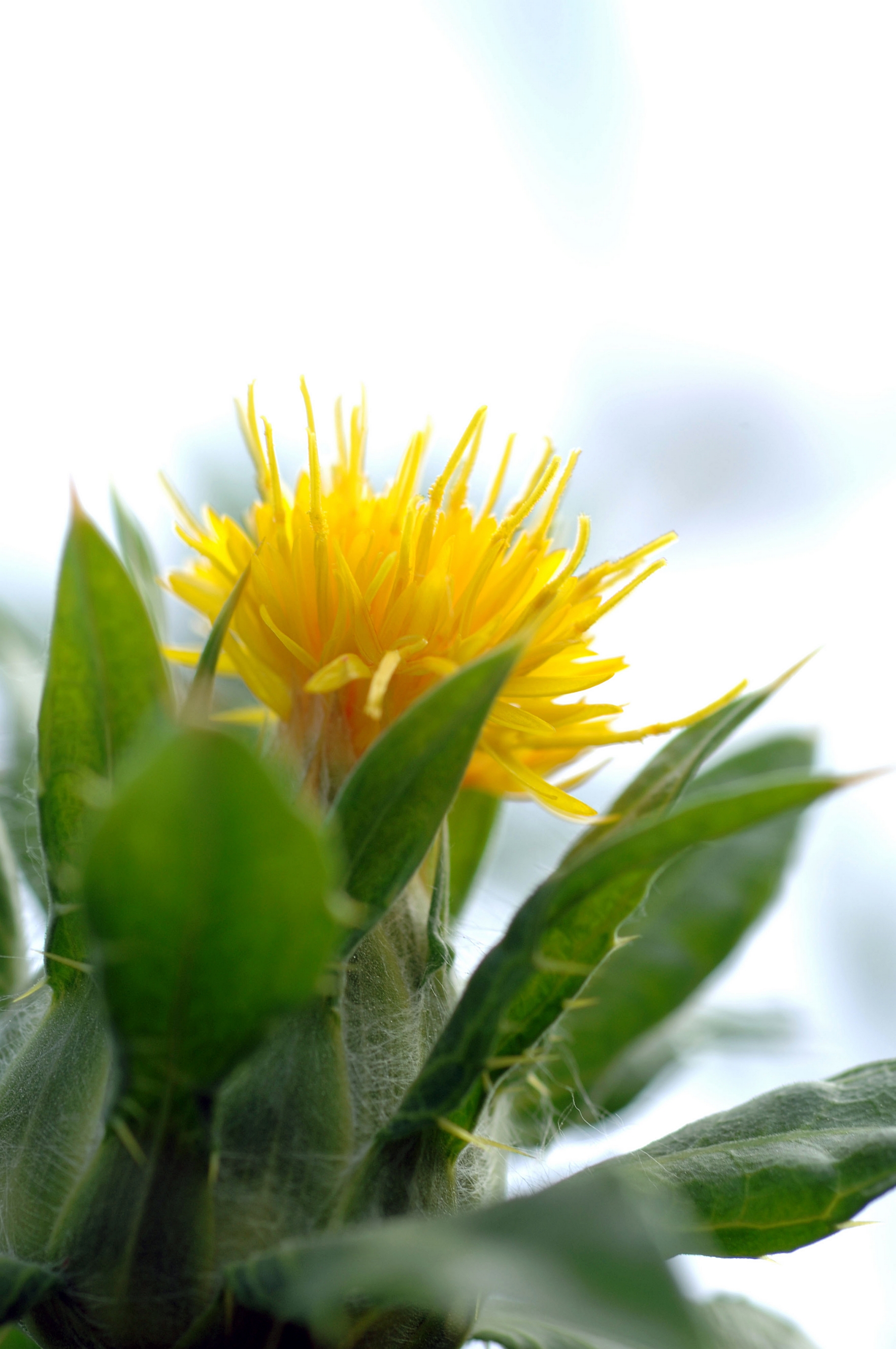
Safflower
Carthamus tinctorius
Safflower (Carthamus tinctorius) is a thistle-like annual oilseed crop grown for edible oil (both high-oleic and high-linoleic types), birdseed, and protein meal. Its defining agronomic trait is a deep taproot that can reach 8-10 feet in deep soils, giving it strong drought tolerance and the ability to draw moisture and nutrients below the reach of small grains — making it a useful crop for dry, deep-soiled rotations and for drawing down excess subsoil moisture in recharge areas. It is a long-season crop, generally needing about 110-120 days from emergence to maturity, and grows best on deep, fertile, well-drained loams. Seedlings tolerate light spring frost during the rosette stage (to about 20F) but the crop is very susceptible to frost during flowering and seed fill, so it is planted early in spring and grown through a long frost-free summer.
Crop Snowflake Score
/acre
/acre
/acre
years
Overview
Plant in early spring once soils reach about 40F for germination, typically mid-April to mid-May; delayed planting past late spring raises the risk of fall-frost injury during flowering and seed fill and lowers seed and oil yield. Sow at 1-1.5 inch depth (no deeper than 2 inches) at 15-30 lb of pure live seed per acre; lower rates increase branching and delay maturity. Seedlings are not vigorous and compete poorly with weeds during the 4-6 week rosette stage, so a strong weed-control program is essential. Safflower tolerates saline soils similarly to barley. It is direct-combined when most leaves have browned; keep cylinder speed moderate to avoid cracking seed, and store at 8% moisture or less. Yields commonly range from about 500 to over 2,500 lb/acre depending on moisture, fertility, and disease pressure. Do not grow in close rotation with sunflower, dry bean, mustard, canola, or lentil due to shared Sclerotinia (white mold) risk.
Growing Season
- Plant
- mid-April – mid-May
- Harvest
- early September – October
- Frost-free days
- 120+
Yield
- Typical yield
- 1,500 lbs/acre
Market Fit
Active Regional Buyers
1 active buyer on record purchasing this crop.
Price Trend Stable/Up
3-year price trend recorded as "declining".
Supply Below Demand
Priced on national grain markets where supply is well established, leaving little regional headroom regardless of local channel strength (1 of 2 channels rate "strong").
Multiple Buyer Channels
1 of 2 documented market channels rate viable or better (wholesale). Thin — dependent on few outlets.
Value-Added Potential
0 viable direct-market channels. Limited direct-market routes; value chiefly captured at wholesale.
Market Growth Projected
Mature grain market; growth over a 5-year horizon is expected to track population rather than outpace it.
Market Channels
Climate Fit
Hardiness Zone Match
Crop tolerates zones 4-10; region spans 5-6. Overlaps.
GDD Sufficient
Crop GDD minimum not recorded. Region accumulates 2500+ GDD (base 50F), sufficient for most temperate crops.
Precipitation Compatible
Crop water requirement not recorded. Region is humid continental with reliable growing-season rainfall; irrigation available as supplement.
Frost-Free Season OK
Crop needs 120 frost-free days; region provides ~180. Sufficient.
Chill Hours Met
Not applicable — annual crop has no winter chill requirement.
Climate Trend Favorable
Crop spans 7 hardiness zones (4-10). Wide adaptive range buffers against warming trend.
Fit by region
The farm matcher, run on each region's cited climate normals. Soil and site are not included here; add your own on the match page.
No limiting condition found. 5 criteria evaluated, 1 not yet researched; 100% cited.
No limiting condition found. 5 criteria evaluated, 1 not yet researched; 100% cited.
No limiting condition found. 5 criteria evaluated, 1 not yet researched; 100% cited.
Climate envelope & site
What the farm matcher compares your conditions against.
Climate envelope
- Hardiness zone
- n/a
- Frost-free season
- 120+ days
- Heat (GDD base 50°F)
- not yet recorded
- Winter chill
- n/a
- Rainfall
- 23.6–55.1 in/yr
Below the minimum, irrigation is needed; above the maximum the crop fails.
- Soil pH target
- 6.0–7.5
Extension lime target; within 1.0 of it is correctable.
Site & structure
- Spring frost at bloom
- n/a
- Needs cold-air drainage
- n/a
- Shade tolerance
- none — full sun
- Mature height
- not yet recorded
- Rooting depth
- not yet recorded
- Wind exposure tolerance
- not yet recorded
- Workable slope
- not yet recorded
Height, rooting depth and shade tolerance are the inputs an alley or guild layout needs.
Soil Compatibility
Soil Texture
Drainage
Infrastructure Fit
Equipment Compatible
2 of 11 documented equipment items are crop-specific (18%) against a catalog median of 29%. Most needs are met by general row-crop or orchard equipment.
Storage Available
1 documented storage route; all require purpose-built capital (Dry seed storage (oil and birdseed)).
Irrigation Compatible
Water requirement not recorded; standard drip or overhead irrigation assumed adequate.
Field Layout Suitable
Grain crops need large contiguous acreage to be economic; the region's parcels are typically small and fragmented by topography.
Labor Availability
Labor requirement not recorded. Catalog 75th percentile is 250 hr/ac.
Processing Proximity
1 processor/cooperative buyer on record for this crop.
Equipment Requirements
planting
Dryland safflower is drilled in 6–10 in. rows at 1–1.5 in. depth; drill settings correspond to similar barley seeding rates.
Use high-germination (>80%) seed treated for seedling diseases; add insecticidal treatment where wireworms are a risk.
cultivation
In wide (22–24 in.) irrigated rows, early between-row cultivation before stem elongation kills small weeds; later cultivation moves soil into the row.
Light harrowing can control weeds emerging before the crop and relieve soil crusting, though it may damage emerging safflower.
spraying
Needed for the essential weed-control program and for foliar fungicide applied at first flower to suppress Alternaria leaf spot.
harvesting
Directly harvested with a small-grain combine; keep cylinder peripheral speed under 3,000 ft/min (~500 rpm on a 22-in. cylinder) to prevent seed cracking.
A white fuzz from seed heads clogs combine radiators and air intakes (overheating and fire hazard); small-mesh screens and daily blow-out mitigate this.
post_harvest
Late or high-moisture harvest may require mechanical drying; keep drying temperatures at or below 110°F to preserve seed quality.
For safe long-term storage, threshed seed should not exceed 8% moisture.
general
General-purpose field tractor to power the drill, sprayer, cultivator and tillage operations across the rotation.
Because roots penetrate beyond 4 ft, sampling deeper than 2 ft improves nitrogen fertilizer recommendation accuracy.
Storage Requirements
Dry seed storage (oil and birdseed)
Temperature
35–60°F
Max Storage
365 days
Financial Return
Revenue Above Average
Gross revenue $268/ac vs catalog median $6,000/ac. Below median.
Input Costs Acceptable
Input cost not recorded; not penalising. Catalog 75th percentile is $6,300/ac.
Payback Period OK
Years to full production not recorded.
Insurance Available
Federal crop insurance or an equivalent risk product is available.
Revenue Per Labor Hour
Cannot compute — net return not recorded. Catalog median is $13.16/hr.
Grants/Subsidies
No specialty-crop or cover-crop incentive program identified for this grain crop.
Economics Breakdown
| Avg Price/Unit | $20/per cwt (US avg) |
| Gross Revenue/Acre | $268 |
| Annual Operating Cost | —/acre |
| Establishment Cost | —/acre |
| Total Input Cost | —/acre |
| Net Return/Acre | — |
| Revenue/Labor Hour | — |
| Crop Insurance | Available |
| Subsidies | PLC (Price Loss Coverage), ARC (Agriculture Risk Coverage), Marketing Assistance Loan |
Source: USDA NASS Crop Values 2025 Summary (Feb 2026): US marketing-year avg price $20.30/cwt 2025 (vs $36.00 2023, $24.30 2024 — declining); value of production $29.1M. Yield from NASS Crop Production 2025 Summary (Jan 2026): US avg 1,319 lb/ac 2025. Gross revenue derived: 13.19 cwt/ac x $20.30 = ~$268/ac (US avg). Cost fields left null — no current enterprise budget found (UC ANR safflower cost study dates to 2005; NDSU 2026 regional budgets omit safflower). Safflower is a western/plains dryland oilseed not commercially grown in this region; US national data used as best-available reference. (2025)
Risk Profile
Manageable Pest/Disease
3 of 11 documented risks are high-severity (27%) against a catalog median of 36%. Risk load is manageable by conventional IPM.
Market Diversified
1 viable market channel of 2 documented, plus 1 named buyer. Concentrated — losing one outlet would strand the crop.
Low Establishment Risk
Establishment timeline not recorded.
Climate Resilient
Tolerates zones 4-10 (7 zones). Broad tolerance indicates resilience to seasonal variability.
Regulatory Burden Low
No crop-specific licensing or reporting regime beyond standard food-safety and pesticide rules.
Diversifies Portfolio
Adds a grain revenue stream distinct from the region's grape-dominated base.
Known Risks
disease
Most serious safflower disease in years of above-normal rainfall and extended high humidity; large brown, irregular spots on leaves and flower bracts reduce photosynthetic tissue and yield.
Sclerotinia rot risk rises when safflower is grown in close rotation with other susceptible broadleaf crops.
Pseudomonas bacterial blight is a minor foliar/head disease of safflower, generally not a problem in dry production areas.
Rust is rarely a problem; the seed-borne spores are readily controlled by seed treatment.
pest
Soil-dwelling wireworm larvae can damage germinating seed and seedlings, reducing stand, particularly following susceptible previous crops.
Cutworms can sever seedlings at or below the soil line, thinning stands in the establishment phase.
Grasshoppers are an occasional defoliating pest, more damaging in dry seasons and along field margins.
weather
Safflower is very susceptible to fall frost injury during flowering and seed development; late planting greatly increases the risk of yield and quality loss.
Safflower seedlings are not vigorous, and soil crusting after planting can reduce emergence and final stand.
environmental
Safflower is a poor competitor with weeds during the 4–6 week rosette stage before stem elongation, making early weed competition a frequent, serious production problem.
market
Nearly all safflower is grown and sold under contract; without a pre-season contract growers face limited outlets and price uncertainty.
Nutritional Yield
Macronutrients
| Nutrient | Per 100 g | Per acre |
|---|---|---|
| Calories | 517 kcal | 2,110,564 kcal |
| Protein | 16.2 g | 66,052 g |
| Total fat | 38.5 g | 156,966 g |
| Carbohydrates | 34.3 g | 139,983 g |
Key micronutrients
Uncertainty: Per-acre values are estimates that compound the yield range, edible-fraction assumption, and a single representative nutrient panel. Treat them as order-of-magnitude planning numbers, not nutritional advice. Confidence: high.
Ecosystem Services
Water regulation
- Deep taproot draws down subsoil moisture in recharge areashigh
The taproot penetrates 8–10 ft in deep soils, making safflower an excellent crop for recharge areas because it accesses surplus water below the rooting depth of small grains.
Applies when: deep soils / saline-seep recharge areasEvidence: Extension guidance·Confidence: high
Climate adaptation
- Drought tolerance for dryland systemshigh
Because of its deep taproot, safflower is more tolerant to drought than small grains and other oilseed crops, adding resilience to dryland rotations.
Applies when: dryland/semi-arid productionEvidence: Extension guidance·Confidence: high
Nutrient cycling
- Scavenges deep nitrogen unavailable to shallow cropsmoderate
Safflower roots reach nutrients such as nitrogen positioned deeper than small grains can access, recovering nitrogen that would otherwise be unused.
Applies when: rotations following shallow-rooted cropsEvidence: Extension guidance·Confidence: high
Soil health
- Rotation crop that diversifies cereal systemsmoderate
Grown in rotation with small grains and legumes, safflower diversifies the cropping sequence; recrop/reduced-tillage after safflower preserves residue and reduces erosion.
Applies when: small-grain rotationsEvidence: Extension guidance·Confidence: medium
Pollinator support
- Late-summer nectar for beesmoderate
Safflower flowers (blooming mid-to-late summer over a 2–3 week period) provide nectar and pollen to honey bees and other foraging insects when many field crops have finished flowering.
Applies when: flowering period retainedEvidence: Industry consensus·Confidence: medium
Cultivars
Named varieties and what the sources say sets each apart. A cultivar-specific zone, chill or maturity figure overrides the species value above.
No cultivars recorded yet for this crop.
Grows With / Avoid Near
Documented interactions with other catalog crops — shared pests, allelopathy, rotation effects, alley and understory pairings — for companion, guild and rotation planning. Plan a combination with Safflower →
Avoid near, or plan around (5)
Direction matters: a rotation benefit of A before B says nothing about B before A. Interactions are documented pairs only; absence is a research gap, not a clean bill.
Nearby Buyers
Data Sources
Every data point on this page is traceable to its source. Below you'll find the complete provenance trail — which sources were used, when data was last verified, and a full change history.
Primary sources: Initial region-neutral entry from NDSU Extension Safflower Production (A870) and USDA PLANTS (CATI). Soil, economics, and risk detail to be populated by later rotations.
Economics data year: 2025 · Basis: lake erie View economics source →
33 tracked changes across 10 data categories