
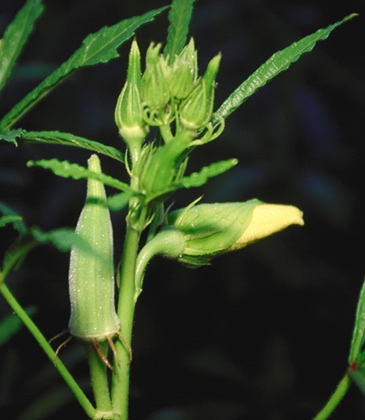
Okra
Abelmoschus esculentus
Heat-loving annual vegetable grown for its tender, edible immature seed pods, widely used in Southern, Cajun, Caribbean, African, and South Asian cuisines. Thrives in hot weather (75-90F) and needs warm soil, at least 65-70F, for reliable germination; seedlings are killed by frost. First pods are ready about 50-60 days after planting, and plants keep producing through the warm season if picked every day or two. A dependable warm-season crop for diversified fresh-market and value-added (pickled, frozen) sales.
Crop Snowflake Score
/acre
/acre
/acre
years
Overview
Okra grows best on well-drained soils at pH 5.8-6.5 and should not be direct-seeded until soil at planting depth reaches 65-70F; cooler soils give poor, uneven stands, and soaking or scarifying seed speeds germination. Optimal air temperatures are 75-90F. Plant populations typically run 7,000-15,000 plants per acre depending on variety and spacing. Pods must be harvested young and tender (usually 2-4 inches, every one to three days); over-mature pods turn woody and slow further flowering, so frequent picking sustains yield. Pods and stems bear stiff hairs that can irritate skin, so harvest crews often wear gloves and long sleeves. Reported commercial yields run on the order of 250 bushels per acre (about four tons; a bushel is roughly 30-35 lb) under good irrigated conditions, with some extension sources citing 10,000-12,000 lb per acre. Okra produces from roughly 50-60 days after planting until killed by the first fall frost.
Growing Season
- Plant
- Late spring, after last frost when soil reaches 65-70F – Early summer
- Harvest
- Mid to late summer (about 50-60 days after planting) – Until first fall frost
- Frost-free days
- 90+
Yield
- Typical yield
- 250 bushels/acre
- Productive lifespan
- 1 years
- Labor
- 260 hrs/acre
Market Fit
Active Regional Buyers
No buyer on record for this crop in the catalog's buyer network.
Price Trend Stable/Up
3-year price trend recorded as "stable".
Supply Below Demand
2 of 6 documented channels rate viability "strong". Sold into regional rather than national markets, vegetable supply here generally trails that demand.
Multiple Buyer Channels
6 of 6 documented market channels rate viable or better (farmers_market, direct_to_consumer, csa, restaurant). Multiple independent routes to market.
Value-Added Potential
4 viable direct-market channels (farmers_market, direct_to_consumer, csa, restaurant). Supports value-added and margin capture beyond wholesale.
Market Growth Projected
Mature vegetable market; growth over a 5-year horizon is expected to track population rather than outpace it.
Market Channels
Climate Fit
Hardiness Zone Match
Crop tolerates zones 5-11; region spans 5-6. Overlaps.
GDD Sufficient
Crop GDD minimum not recorded. Region accumulates 2500+ GDD (base 50F), sufficient for most temperate crops.
Precipitation Compatible
Crop water requirement not recorded. Region is humid continental with reliable growing-season rainfall; irrigation available as supplement.
Frost-Free Season OK
Crop needs 90 frost-free days; region provides ~180. Sufficient.
Chill Hours Met
Not applicable — annual crop has no winter chill requirement.
Climate Trend Favorable
Crop spans 7 hardiness zones (5-11). Wide adaptive range buffers against warming trend.
Fit by region
The farm matcher, run on each region's cited climate normals. Soil and site are not included here; add your own on the match page.
No limiting condition found. 5 criteria evaluated, 2 not yet researched; 100% cited.
No limiting condition found. 5 criteria evaluated, 2 not yet researched; 100% cited.
No limiting condition found. 5 criteria evaluated, 2 not yet researched; 100% cited.
Climate envelope & site
What the farm matcher compares your conditions against.
Climate envelope
- Hardiness zone
- n/a
- Frost-free season
- 90+ days
- Heat (GDD base 50°F)
- not yet recorded
- Winter chill
- n/a
- Rainfall
- 23.6–98.4 in/yr
Below the minimum, irrigation is needed; above the maximum the crop fails.
- Soil pH target
- 5.8–6.5
Extension lime target; within 1.0 of it is correctable.
Site & structure
- Spring frost at bloom
- n/a
- Needs cold-air drainage
- n/a
- Shade tolerance
- none — full sun
- Mature height
- not yet recorded
- Rooting depth
- not yet recorded
- Wind exposure tolerance
- not yet recorded
- Workable slope
- not yet recorded
Height, rooting depth and shade tolerance are the inputs an alley or guild layout needs.
Soil Compatibility
Soil Texture
Drainage
Infrastructure Fit
Equipment Compatible
0 of 10 documented equipment items are crop-specific (0%) against a catalog median of 29%. Most needs are met by general row-crop or orchard equipment.
Storage Available
2 documented storage routes; at least one (Fresh cold storage) is reachable with conventional on-farm or third-party facilities.
Irrigation Compatible
Water requirement not recorded; standard drip or overhead irrigation assumed adequate.
Field Layout Suitable
Suited to the small-to-mid-size fragmented parcels typical of the region.
Labor Availability
150 labor hr/ac vs catalog 75th percentile 250 hr/ac. Manageable with typical farm labor.
Processing Proximity
No processing or cooperative buyer on record for this crop; product would need to travel or be sold fresh.
Equipment Requirements
planting
General-purpose tractor for tillage, bed prep, cultivation, and spraying. Fixed cost shared across the operation.
Places large okra seed at uniform depth and spacing for even emergence; okra is typically direct-seeded into warm soil.
Optional black-plastic bed system that warms soil to advance planting and extend the season for this heat-loving crop in cooler regions.
irrigation
Supplies steady moisture during pod set and keeps foliage dry to limit leaf spot. Per-acre consumable cost.
spraying
Applies insecticides for stink bug, aphid, and earworm management and fungicides for leaf/pod spot.
cultivation
Between-row mechanical weed control during early growth before the canopy closes.
harvesting
Okra is hand-cut every 1-2 days because pods toughen fast; spines/irritant hairs require gloves and long sleeves. Per-crew consumable.
Shallow vented totes prevent pod bruising during frequent picks and move harvest out of the field promptly.
post_harvest
Removes field heat to slow toughening and blackening; okra is chilling-sensitive and held near 7-10 °C, not colder.
Sorts pods by length and quality (tender, blemish-free) for fresh-market packs.
Storage Requirements
Fresh cold storage
Temperature
45–50°F
Humidity
95–100%
Max Storage
10 days
Controlled atmosphere (4-10% CO2)
Temperature
45–50°F
Humidity
95–100%
Max Storage
14 days
Financial Return
Revenue Above Average
Gross revenue $6,000/ac vs catalog median $6,000/ac. Below median.
Input Costs Acceptable
Input cost not recorded; not penalising. Catalog 75th percentile is $6,300/ac.
Payback Period OK
Reaches full production in 0 years. Acceptable payback.
Insurance Available
No federal crop insurance recorded for this crop; risk sits with the grower.
Revenue Per Labor Hour
Cannot compute — net return not recorded. Catalog median is $13.16/hr.
Grants/Subsidies
Vegetable crops are eligible under the USDA Specialty Crop Block Grant Program.
Economics Breakdown
| Avg Price/Unit | $1/per lb (fresh-market, conservative) |
| Gross Revenue/Acre | $6,000 |
| Annual Operating Cost | —/acre |
| Establishment Cost | —/acre |
| Total Input Cost | —/acre |
| Net Return/Acre | — |
| Revenue/Labor Hour | — |
| Crop Insurance | Not available |
Source: Oklahoma State University Extension (yields); UC ANR Small Farms Network okra cost study (price basis); USDA AMS terminal market (Jul 2026); UGA Extension C627 (2025)
Risk Profile
Manageable Pest/Disease
3 of 10 documented risks are high-severity (30%) against a catalog median of 36%. Risk load is manageable by conventional IPM.
Market Diversified
6 viable market channels of 6 documented. Not dependent on a single outlet.
Low Establishment Risk
0 years to full production. Low establishment exposure.
Climate Resilient
Tolerates zones 5-11 (7 zones). Broad tolerance indicates resilience to seasonal variability.
Regulatory Burden Low
No crop-specific licensing or reporting regime beyond standard food-safety and pesticide rules.
Diversifies Portfolio
Adds a vegetable revenue stream distinct from the region's grape-dominated base.
Known Risks
disease
Soilborne fungus that invades the vascular system, causing yellowing, wilting, internal stem browning, stunting, and plant death. The pathogen persists in soil for years and is worse in warm soils and where okra or cotton was grown recently.
Microscopic soil roundworms that form galls on roots, producing stunted, yellow, drought-prone, poorly producing plants. Damage is most severe in warm, sandy soils and where susceptible crops were grown previously.
Fungal leaf spots (Cercospora abelmoschi, Alternaria spp.) produce angular to circular lesions and defoliation in warm, humid weather, and can blemish pods, lowering fresh-market quality.
Hot-weather soilborne fungus that girdles the stem at the soil line with a white mycelial mat and tan, mustard-seed-like sclerotia, causing sudden wilt and collapse of individual plants.
pest
Aphids feed on okra sap on growing points and leaf undersides, producing honeydew and sooty mold and occasionally transmitting viruses; heavy infestations distort new growth.
Piercing-sucking feeding on developing pods causes warts, twisting, and distortion that downgrades fresh-market pods; bugs move in from weedy borders and adjacent crops.
Caterpillars bore into buds, flowers, and pods, causing direct pod damage and entry wounds for rot. Pressure rises mid- to late season as regional moth flights peak.
Adults chew small shotholes in seedling leaves; heavy early feeding can slow establishment of young okra, though established plants tolerate damage well.
weather
Okra is a tropical warm-season crop that germinates poorly below ~18 °C soil temperature, suffers chilling injury in cool weather, and is killed by frost, sharply limiting the planting window in temperate regions.
market
Fresh okra pods are highly perishable, toughening, bruising, and blackening within a few days of harvest, and demand is concentrated in regional, Southern, and ethnic markets, limiting wholesale outlets.
Nutritional Yield
Macronutrients
| Nutrient | Per 100 g | Per acre |
|---|---|---|
| Calories | 33 kcal | 836,713 kcal |
| Protein | 1.9 g | 48,935 g |
| Total fat | 0.2 g | 4,817 g |
| Carbohydrates | 7.5 g | 188,894 g |
| Fiber | 3.2 g | 81,136 g |
| Sugar | 1.5 g | 37,525 g |
Key micronutrients
Uncertainty: Per-acre values are estimates that compound the yield range, edible-fraction assumption, and a single representative nutrient panel. Treat them as order-of-magnitude planning numbers, not nutritional advice. Confidence: high.
Ecosystem Services
Pollinator support
- Nectar-rich flowers attractive to beesmoderate
Okra produces large, showy, nectar-rich hibiscus-type flowers that are readily visited by honey bees and native bees, providing summer forage during bloom.
Applies when: flowering crop with pollinators presentEvidence: Extension guidance·Confidence: high
Climate adaptation
- Heat and drought tolerancemoderate
Okra is exceptionally heat- and drought-tolerant, producing reliably in hot conditions that stress many vegetables, making it a resilient option for warm-season diversification under a warming climate.
Applies when: hot-summer or drought-prone production regionsEvidence: Extension guidance·Confidence: high
Cultural / aesthetic
- Regional culinary and local-market valuemoderate
Okra is a culturally important vegetable in Southern, Caribbean, African, and South Asian cuisines, supporting strong local, ethnic-market, and direct-sale value for diversified growers.
Applies when: direct and ethnic-market sales channelsEvidence: Industry consensus·Confidence: medium
Soil health
- Deep taproot and residue contributionlow
Okra develops a deep taproot that can improve soil structure and access deep moisture, and its substantial biomass returns organic residue when incorporated after harvest.
Applies when: residue incorporated after harvestEvidence: Extension guidance·Confidence: medium
Pest suppression
- Trap-crop and beneficial-habitat rolelow
Okra is used as a trap crop for stink bugs and leaffooted bugs in some systems and its flowers support beneficial insects, which can aid pest management on adjacent crops.
Applies when: interplanted or border plantings managed for beneficialsEvidence: Extension guidance·Confidence: medium
Cultivars
Named varieties and what the sources say sets each apart. A cultivar-specific zone, chill or maturity figure overrides the species value above.
No cultivars recorded yet for this crop.
Grows With / Avoid Near
Documented interactions with other catalog crops — shared pests, allelopathy, rotation effects, alley and understory pairings — for companion, guild and rotation planning. Plan a combination with Okra →
Avoid near, or plan around (10)
Direction matters: a rotation benefit of A before B says nothing about B before A. Interactions are documented pairs only; absence is a research gap, not a clean bill.
Nearby Buyers
Data Sources
Every data point on this page is traceable to its source. Below you'll find the complete provenance trail — which sources were used, when data was last verified, and a full change history.
Primary sources: Data sourced from Clemson HGIC, University of Georgia Extension (Commercial Okra Production C627), NC State Extension, and Oklahoma State University Extension.
Economics data year: 2025 · Basis: lake erie View economics source →
54 tracked changes across 11 data categories