
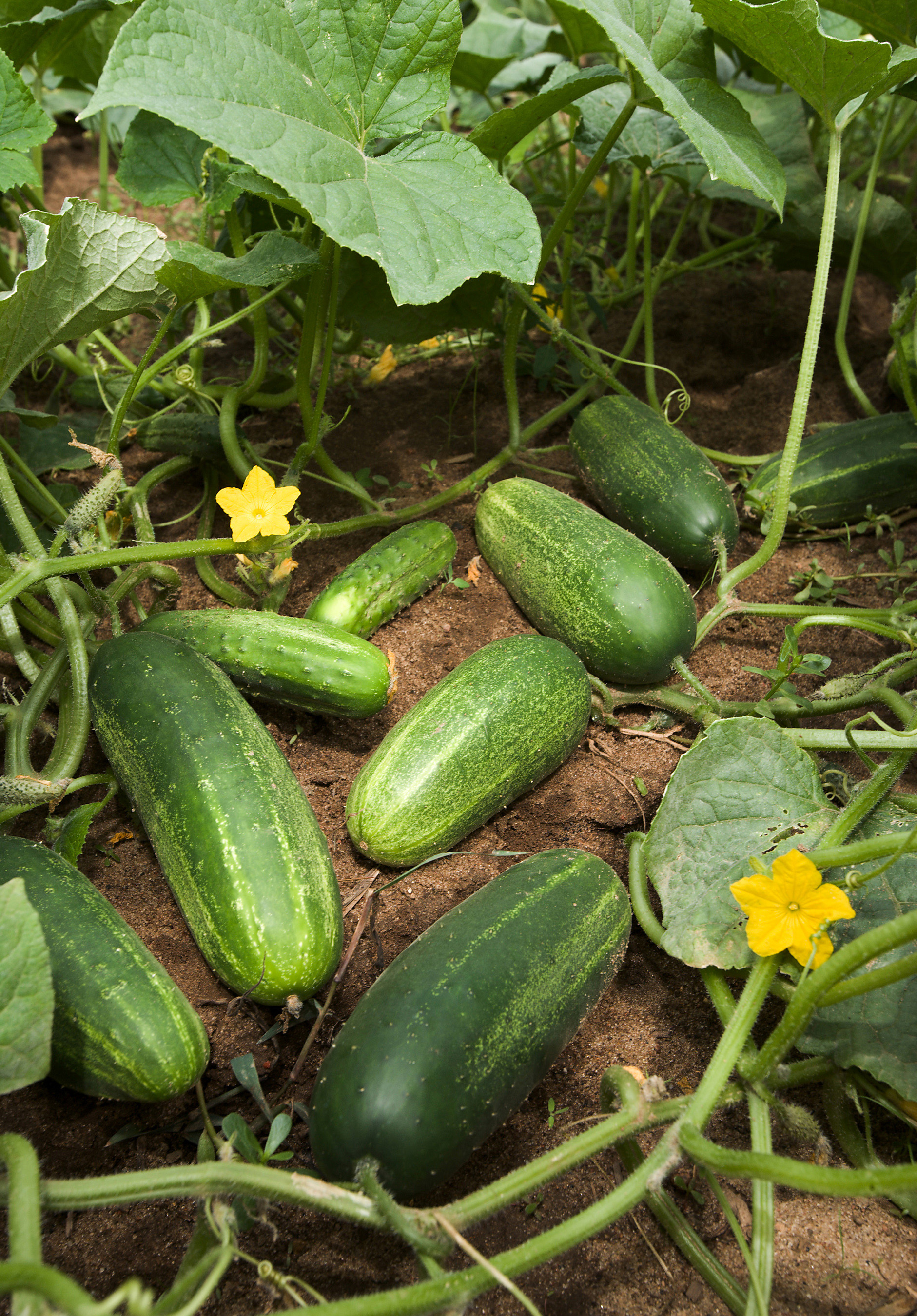
Cucumber
Cucumis sativus
Warm-season annual cucurbit grown for fresh slicing and processing (pickling) fruit. A frost-sensitive vine adapted to warm summers across Zones 3-11 as a single-season crop, cucumber germinates and grows only in warm soils and is direct-seeded or transplanted once soil reaches about 60°F. It performs best on well-drained, fertile loams with a soil pH of roughly 6.0-6.8 and consistent moisture of about 1-2 inches per week, since water stress during fruiting causes misshapen, bitter fruit. Pickling and slicing types differ in fruit size, spacing, and harvest method, with pickling types often grown at high density for once-over machine harvest and slicing types on wider spacing for repeated hand harvest.
Crop Snowflake Score
/acre
/acre
/acre
years
Overview
Cucumber (Cucumis sativus) is a warm-season annual cucurbit, frost-sensitive and dependent on warm soils: seed when soil temperatures exceed 60°F and night air stays above 50°F. Pickling cucumbers for once-over (machine) harvest are grown at high populations of roughly 50,000-70,000 plants per acre (rows ~30 inches apart, plants 3-4 inches in-row), while multiple-hand-harvest pickling is planted in wider rows; slicing cucumbers are typically single rows on plastic mulch with 9-12 inches between plants and 5-7 feet between rows. Many varieties reach first harvest about 50-60 days from seeding, and fields should be picked 2-3 times weekly for quality and continued set. Average pickling yields are commonly 200-250 bushels per acre, with 500-600 bu/ac achievable under good management. Cucumbers are monoecious, gynoecious, or parthenocarpic depending on type; bee pollination is critical for seeded (non-parthenocarpic) types. Major pests and diseases include cucumber beetles (which also vector bacterial wilt), aphids, downy and powdery mildew, angular leaf spot, and various mosaic viruses; floating row covers, resistant varieties, and timely fungicide programs are standard management. Optimal storage is cool but not cold (about 50-55°F) to avoid chilling injury.
Growing Season
- Plant
- Late spring after frost danger has passed, once soil reaches 60°F at 3 inches deep – Mid summer (successive plantings extend harvest)
- Harvest
- Early-to-mid summer; first pickling harvest about 50 days after seeding – Early fall (until first frost), harvesting 2-3 times per week
- Frost-free days
- 55+
- GDD (base 50°F)
- 946
Yield
- Typical yield
- 250 bu/acre (pickling, ~48 lb/bu)
- Productive lifespan
- 1 years
- Years to full prod.
- 1
Market Fit
Active Regional Buyers
1 active buyer on record purchasing this crop.
Price Trend Stable/Up
3-year price trend recorded as "stable".
Supply Below Demand
4 of 6 documented channels rate viability "strong". Sold into regional rather than national markets, vegetable supply here generally trails that demand.
Multiple Buyer Channels
6 of 6 documented market channels rate viable or better (wholesale, retail, farmers_market, direct_to_consumer). Multiple independent routes to market.
Value-Added Potential
4 viable direct-market channels (farmers_market, direct_to_consumer, csa, restaurant). Supports value-added and margin capture beyond wholesale.
Market Growth Projected
Mature vegetable market; growth over a 5-year horizon is expected to track population rather than outpace it.
Market Channels
Climate Fit
Hardiness Zone Match
Crop tolerates zones 3-11; region spans 5-6. Overlaps.
GDD Sufficient
Crop GDD minimum not recorded. Region accumulates 2500+ GDD (base 50F), sufficient for most temperate crops.
Precipitation Compatible
Crop needs ~18 in; region receives ~38 in/yr. Compatible, irrigation available as supplement.
Frost-Free Season OK
Crop needs 55 frost-free days; region provides ~180. Sufficient.
Chill Hours Met
Not applicable — annual crop has no winter chill requirement.
Climate Trend Favorable
Crop spans 9 hardiness zones (3-11). Wide adaptive range buffers against warming trend.
Fit by region
The farm matcher, run on each region's cited climate normals. Soil and site are not included here; add your own on the match page.
Limited by rainfall, high-severity risks. 5 criteria evaluated; 100% cited.
Limited by high-severity risks. 5 criteria evaluated; 100% cited.
Limited by high-severity risks. 5 criteria evaluated; 100% cited.
Climate envelope & site
What the farm matcher compares your conditions against.
Climate envelope
- Hardiness zone
- n/a
- Frost-free season
- 55+ days
- Heat (GDD base 50°F)
- 946+
- Winter chill
- n/a
- Rainfall
- 39.4–169.3 in/yr
Below the minimum, irrigation is needed; above the maximum the crop fails.
- Soil pH target
- 6.0–6.8
Extension lime target; within 1.0 of it is correctable.
Site & structure
- Spring frost at bloom
- n/a
- Needs cold-air drainage
- n/a
- Shade tolerance
- none — full sun
- Mature height
- not yet recorded
- Rooting depth
- not yet recorded
- Wind exposure tolerance
- not yet recorded
- Workable slope
- not yet recorded
Height, rooting depth and shade tolerance are the inputs an alley or guild layout needs.
Soil Compatibility
Soil Texture
Drainage
Infrastructure Fit
Equipment Compatible
2 of 11 documented equipment items are crop-specific (18%) against a catalog median of 29%. Most needs are met by general row-crop or orchard equipment.
Storage Available
3 documented storage routes; at least one (Fresh cold storage (chilling-sensitive)) is reachable with conventional on-farm or third-party facilities.
Irrigation Compatible
Requires ~18 in. Deliverable with conventional drip or overhead irrigation.
Field Layout Suitable
Suited to the small-to-mid-size fragmented parcels typical of the region.
Labor Availability
Labor requirement not recorded. Catalog 75th percentile is 250 hr/ac.
Processing Proximity
1 processor/cooperative buyer on record for this crop, 1 within NY/PA/OH.
Equipment Requirements
planting
General-purpose tractor for tillage, bed forming, spraying, and transport across the operation. Fixed cost shared across vegetable crops.
Lays raised beds, black plastic mulch, and drip tape in one pass to warm soil, suppress weeds, and conserve moisture for warm-season cucumbers.
Singulates cucumber seed at target spacing for uniform stands, or sets transplants for earlier harvest in short-season regions.
irrigation
Delivers water and fertigation to the root zone while keeping foliage dry, which reduces foliar bacterial and fungal disease pressure. Per-acre consumable cost.
spraying
Applies protectant and targeted fungicides on the tight intervals required for downy and powdery mildew, plus insecticides for beetle/aphid management.
cultivation
Mechanical between-row weed control on bare-ground plantings before vines run, reducing herbicide reliance.
general
Excludes cucumber beetles (and the bacterial wilt they vector) during the seedling stage; removed at flowering to allow pollination. Per-acre consumable.
harvesting
Belt or harvest-aid rig that moves hand-picked fruit from the field to bins, reducing labor on repeated multi-pick fresh-market harvests.
Specialized destructive harvester for contracted processing/pickling cucumbers grown at high density for a single mechanical pass. Justified only at processing scale.
post_harvest
Removes field heat quickly after harvest to preserve firmness and shelf life; cucumbers are chilling-sensitive, so cooling targets ~10-12 °C, not colder.
Washes, sorts, and grades fruit by size and curvature to meet fresh-market cosmetic standards before packing.
Storage Requirements
Fresh cold storage (chilling-sensitive)
Temperature
50–55°F
Humidity
90–95%
Max Storage
14 days
Waxed or film-wrapped (retail)
Temperature
50–55°F
Humidity
90–95%
Max Storage
14 days
Brined storage (pickling stock)
Temperature
50–70°F
Max Storage
365 days
Financial Return
Revenue Above Average
Gross revenue $1,588/ac vs catalog median $6,000/ac. Below median.
Input Costs Acceptable
Input cost not recorded; not penalising. Catalog 75th percentile is $6,300/ac.
Payback Period OK
Reaches full production in 1 year. Acceptable payback.
Insurance Available
No federal crop insurance recorded for this crop; risk sits with the grower.
Revenue Per Labor Hour
Cannot compute — net return not recorded. Catalog median is $13.16/hr.
Grants/Subsidies
Vegetable crops are eligible under the USDA Specialty Crop Block Grant Program.
Economics Breakdown
| Avg Price/Unit | $13/$/cwt (processing) |
| Gross Revenue/Acre | $1,588 |
| Annual Operating Cost | —/acre |
| Establishment Cost | —/acre |
| Total Input Cost | —/acre |
| Net Return/Acre | — |
| Revenue/Labor Hour | — |
| Crop Insurance | Not available |
Source: USDA NASS Vegetables 2024 Summary (released Feb 2025): Michigan processing cucumber price $12.70/cwt and yield 125 cwt/ac (2024). Michigan is the leading US processing/pickling cucumber state and lies in the Great Lakes region. Gross revenue 125 cwt x $12.70 = ~$1,588/ac. Granular cost/return fields left null pending a current Great Lakes enterprise budget (MSU E3166 is 2010 and too stale to cite). (2026)
Risk Profile
Manageable Pest/Disease
4 of 11 documented risks are high-severity (36%) against a catalog median of 36%. Risk load is manageable by conventional IPM.
Market Diversified
6 viable market channels of 6 documented, plus 1 named buyer. Not dependent on a single outlet.
Low Establishment Risk
1 year to full production. Low establishment exposure.
Climate Resilient
Tolerates zones 3-11 (9 zones). Broad tolerance indicates resilience to seasonal variability.
Regulatory Burden Low
No crop-specific licensing or reporting regime beyond standard food-safety and pesticide rules.
Diversifies Portfolio
Adds a vegetable revenue stream distinct from the region's grape-dominated base.
Known Risks
disease
Airborne oomycete and the primary yield-limiting foliar disease of cucumber. Produces a mosaic pattern of vein-bounded chlorosis and necrosis on the upper leaf surface with gray, downy sporulation on the underside. An aggressive strain established since the mid-2000s can defoliate plantings rapidly under cool, humid conditions.
Bacterium introduced and spread by cucumber beetles. Infected vines wilt progressively and die; a cut stem exudes sticky bacterial strands that string out between the cut ends. Once a plant is infected there is no cure, so vector control is the management lever.
White, powdery fungal colonies on leaves and petioles that cause premature leaf senescence, reduced photosynthesis, smaller fruit, and increased fruit sunscald. Favored by moderate temperatures and dense canopies.
Seedborne bacterial disease producing angular, water-soaked lesions bounded by leaf veins that dry and tear, giving a tattered appearance; can also spot fruit. Spread by splashing water and handling of wet foliage.
Soilborne water mold that causes crown collapse and a white, yeasty fruit rot, especially where water ponds. Persists for years in soil and is favored by saturated soils and warm, wet weather.
pest
Key early-season pest. Adults feed on cotyledons, foliage, and rinds and, critically, transmit the bacterial wilt pathogen. Even low populations can be damaging on wilt-susceptible cucumbers at the seedling stage.
Colonizes leaf undersides, removing sap and excreting honeydew that supports sooty mold and fouls fruit; also transmits cucumber mosaic and other viruses. Populations can explode in warm weather.
Hot, dry conditions favor rapid mite buildup; feeding causes leaf stippling, bronzing, and webbing that reduces photosynthesis and can collapse the canopy late season.
weather
Cucumber is a warm-season crop injured below roughly 10 °C and killed by frost. Cold, wet soils slow germination and increase seedling damping-off, delaying stand establishment.
Most cucumbers require insect pollination; inadequate bee activity or high temperatures cause poor fruit set, misshapen (nubbin/crooked) fruit, and blossom drop. Heat and moisture swings also drive bitterness.
market
Fresh slicing and pickling cucumbers are highly perishable and prone to seasonal oversupply that compresses prices; cosmetic standards (curvature, color, size) cause significant grade-out of marketable yield.
Nutritional Yield
Macronutrients
| Nutrient | Per 100 g | Per acre |
|---|---|---|
| Calories | 15 kcal | 791,957 kcal |
| Protein | 0.7 g | 34,318 g |
| Total fat | 0.1 g | 5,808 g |
| Carbohydrates | 3.6 g | 191,653 g |
| Fiber | 0.5 g | 26,399 g |
| Sugar | 1.7 g | 88,171 g |
Key micronutrients
Uncertainty: Per-acre values are estimates that compound the yield range, edible-fraction assumption, and a single representative nutrient panel. Treat them as order-of-magnitude planning numbers, not nutritional advice. Confidence: high.
Ecosystem Services
Pollinator support
- Bee forage from abundant nectar-rich bloommoderate
Cucumber plants produce many nectar- and pollen-rich flowers over a long bloom period that support honey bees and native bees; the crop itself depends on this pollinator activity for fruit set, and field margins benefit foraging bees.
Applies when: flowering crop with managed or wild pollinators presentEvidence: Extension guidance·Confidence: high
Cultural / aesthetic
- Local-food and agritourism valuemoderate
Fresh cucumbers and pickling cucumbers are staple local-market and U-pick crops that support direct-marketing, farm-stand, and agritourism value in diversified vegetable operations.
Applies when: direct-market or diversified vegetable operationsEvidence: Industry consensus·Confidence: medium
Soil health
- Living-mulch and cover-crop compatibilitylow
Cucumber is commonly grown with cover crops or no-till/strip-till systems and plastic-mulch alternatives that maintain soil cover, supporting soil organic matter and biological activity between cash crops.
Applies when: grown in rotation with cover crops or reduced tillageEvidence: Extension guidance·Confidence: medium
Pest suppression
- Habitat for aphid and beetle natural enemieslow
Unsprayed cucumber field margins and flowering insectary strips support lady beetles, lacewings, hoverflies, and parasitoids that help suppress aphids and other pests in the crop.
Applies when: natural enemies conserved with selective spray programsEvidence: Extension guidance·Confidence: medium
Water regulation
- Plastic-mulch runoff trade-off and drip efficiencylow
Drip-irrigated cucumber uses water efficiently at the root zone, but plasticulture beds increase surface runoff; in-row and between-row cover practices moderate this effect.
Applies when: plasticulture systems with drip irrigationEvidence: Extension guidance·Confidence: medium
Cultivars
Named varieties and what the sources say sets each apart. A cultivar-specific zone, chill or maturity figure overrides the species value above.
No cultivars recorded yet for this crop.
Grows With / Avoid Near
Documented interactions with other catalog crops — shared pests, allelopathy, rotation effects, alley and understory pairings — for companion, guild and rotation planning. Plan a combination with Cucumber →
Avoid near, or plan around (35)
Grows with (7)
Direction matters: a rotation benefit of A before B says nothing about B before A. Interactions are documented pairs only; absence is a research gap, not a clean bill.
Nearby Buyers
Eden Valley Growers
Eden, NY · 30.0 mi
Data Sources
Every data point on this page is traceable to its source. Below you'll find the complete provenance trail — which sources were used, when data was last verified, and a full change history.
Primary sources: USDA PLANTS (CUSA4); NC State Extension Commercial Production of Pickling and Slicing Cucumbers (spacing, populations, yield, timing); Penn State Extension Cucumber Production (soil temperature, planting). Soil pH 6.0-6.8 per extension consensus. GDD and precipitation ranges left null pending sourced values. Region-neutral encyclopedia entry.
Economics data year: 2026 · Basis: lake erie View economics source →
43 tracked changes across 10 data categories