
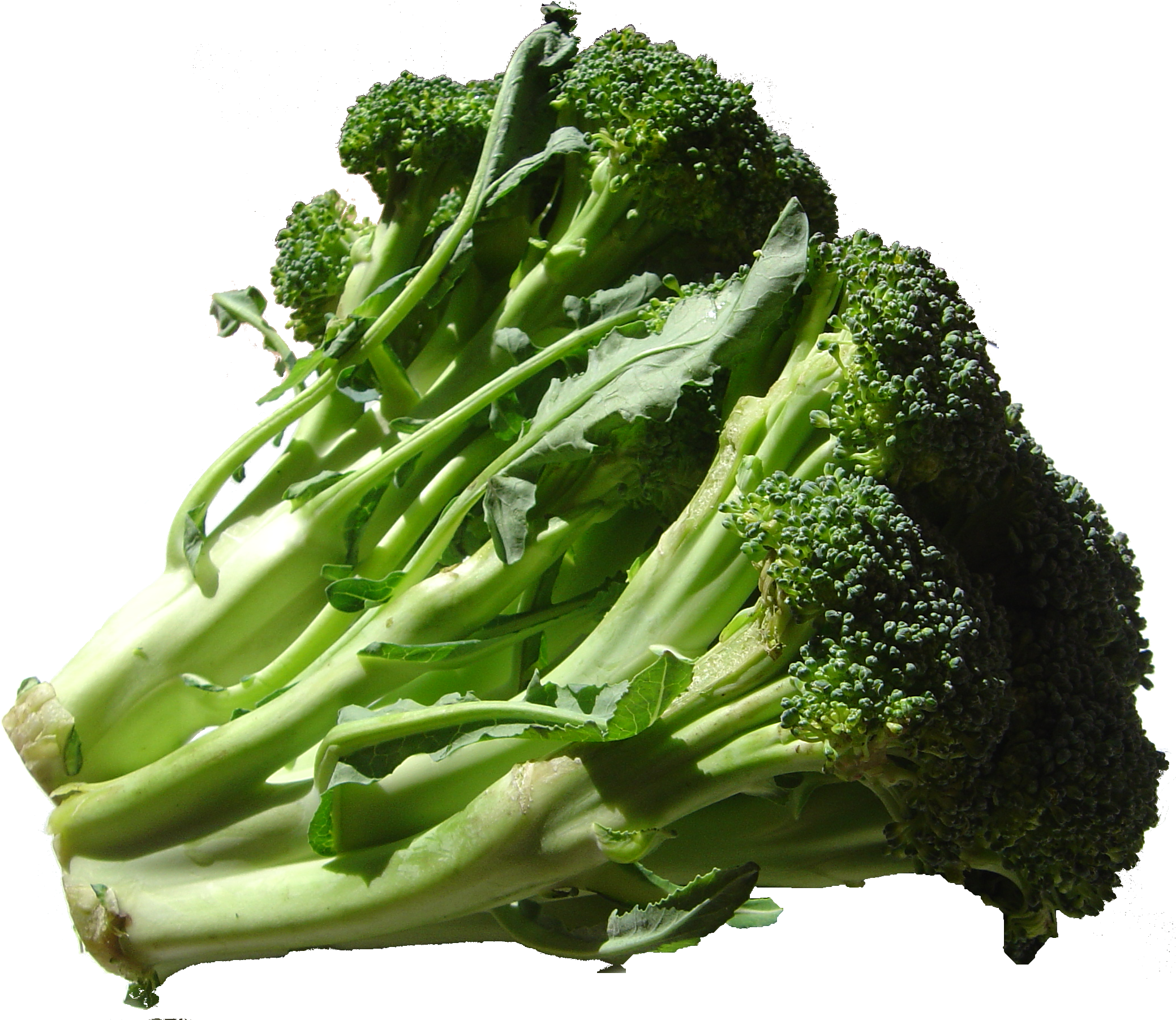
Broccoli
Brassica oleracea (Italica group)
Cool-season cole crop (Brassica oleracea, Italica group — the same species as cabbage, cauliflower, and kale), grown as an annual for its immature green flower head (the central crown plus, in some types, secondary side shoots). Adapted to USDA hardiness zones 3-10 with timing and cultivar selection; it is a frost-tolerant crop that develops best heads under steady cool conditions of roughly 60-70F and is prone to quality defects when it heads during hot weather. Most production is timed so that head development falls in the cool part of the season: spring plantings transplanted or direct-seeded for early-summer harvest, and mid- to late-summer plantings for fall harvest; in mild-winter zones (8 and warmer) fall and overwinter plantings extend supply. Marketed primarily as fresh crown-cut bunches and increasingly as processed florets (fresh-cut, frozen). It is among the more labor-intensive field vegetables because heads mature unevenly and are hand-cut over several passes.
Crop Snowflake Score
/acre
/acre
/acre
years
Overview
Optimal growing temperature is about 60-70F; sustained heat above roughly 80F during head formation causes uneven 'riced' or loose heads, bracting (small leaves in the head), premature flowering, and bitter flavor, while plants exposed to prolonged cold (about 10 days below 40F) after reaching a juvenile threshold can 'button' into tiny premature heads. Broccoli is a heavy feeder, especially of nitrogen and boron; boron and molybdenum deficiencies cause hollow stem and whiptail respectively, so tissue testing and balanced fertility are important. Typical fresh-market yield is on the order of 150-160 cwt/acre. Major insect pests include cabbage looper, diamondback moth, imported cabbageworm, aphids, flea beetles, and harlequin bug; key diseases include black rot (Xanthomonas), downy mildew, Alternaria, white mold (Sclerotinia), and clubroot. Rotate at least 3 years away from other brassicas and manage soil pH near neutral to suppress clubroot. Heads are highly perishable and respire fast: harvest in the cool of the morning, cool immediately (hydro- or package-icing/vacuum cooling), and hold at 32F and 95-100% relative humidity, where quality lasts only about 10-14 days. Spacing and single- vs multiple-harvest systems vary by whether the crop is grown for one large central crown or for repeated side-shoot picking.
Growing Season
- Plant
- early spring – late summer
- Harvest
- late spring – late fall
- Frost-free days
- 55+
- GDD (base 50°F)
- 1,000 – 1,400
Yield
- Typical yield
- 158 cwt/acre
- Productive lifespan
- 1 years
- Labor
- 150 hrs/acre
Market Fit
Active Regional Buyers
1 active buyer on record purchasing this crop.
Price Trend Stable/Up
3-year price trend recorded as "declining".
Supply Below Demand
2 of 6 documented channels rate viability "strong". Sold into regional rather than national markets, vegetable supply here generally trails that demand.
Multiple Buyer Channels
6 of 6 documented market channels rate viable or better (wholesale, retail, farmers_market, direct_to_consumer). Multiple independent routes to market.
Value-Added Potential
4 viable direct-market channels (farmers_market, direct_to_consumer, csa, restaurant). Supports value-added and margin capture beyond wholesale.
Market Growth Projected
Mature vegetable market; growth over a 5-year horizon is expected to track population rather than outpace it.
Market Channels
Climate Fit
Hardiness Zone Match
Crop tolerates zones 3-10; region spans 5-6. Overlaps.
GDD Sufficient
Crop needs 1000 GDD (base 50F); region accumulates 2500+. Sufficient.
Precipitation Compatible
Crop needs ~20 in; region receives ~38 in/yr. Compatible, irrigation available as supplement.
Frost-Free Season OK
Crop needs 55 frost-free days; region provides ~180. Sufficient.
Chill Hours Met
Not applicable — biennial crop has no winter chill requirement.
Climate Trend Favorable
Crop spans 8 hardiness zones (3-10). Wide adaptive range buffers against warming trend.
Fit by region
The farm matcher, run on each region's cited climate normals. Soil and site are not included here; add your own on the match page.
Limited by high-severity risks. 5 criteria evaluated; 80% cited.
Limited by high-severity risks. 5 criteria evaluated; 80% cited.
Limited by high-severity risks. 5 criteria evaluated; 80% cited.
Climate envelope & site
What the farm matcher compares your conditions against.
Climate envelope
- Hardiness zone
- n/a
- Frost-free season
- 55+ days
- Heat (GDD base 50°F)
- 1,000+
- Winter chill
- n/a
- Rainfall
- 35.4–78.7 in/yr
Below the minimum, irrigation is needed; above the maximum the crop fails.
- Soil pH target
- 5.8–6.6
Extension lime target; within 1.0 of it is correctable.
Site & structure
- Spring frost at bloom
- n/a
- Needs cold-air drainage
- n/a
- Shade tolerance
- partial
- Mature height
- not yet recorded
- Rooting depth
- not yet recorded
- Wind exposure tolerance
- not yet recorded
- Workable slope
- not yet recorded
Height, rooting depth and shade tolerance are the inputs an alley or guild layout needs.
Soil Compatibility
Soil Texture
Drainage
Infrastructure Fit
Equipment Compatible
5 of 11 documented equipment items are crop-specific (45%) against a catalog median of 29%. Above-median share of purpose-built equipment, implying real capital outlay.
Storage Available
4 documented storage routes; at least one (Fresh cold storage) is reachable with conventional on-farm or third-party facilities.
Irrigation Compatible
Requires ~20 in. Deliverable with conventional drip or overhead irrigation.
Field Layout Suitable
Suited to the small-to-mid-size fragmented parcels typical of the region.
Labor Availability
150 labor hr/ac vs catalog 75th percentile 250 hr/ac. Manageable with typical farm labor.
Processing Proximity
1 processor/cooperative buyer on record for this crop, 1 within NY/PA/OH.
Equipment Requirements
planting
Broccoli is most commonly established from transplants for uniform stand and maturity. Water-wheel or carousel transplanters set plugs at uniform spacing with starter water. Typical range $8,000-20,000 depending on rows and automation.
Used where broccoli is direct-seeded rather than transplanted; meters single seeds at target spacing to reduce thinning. Typical range $3,000-15,000.
irrigation
Consistent soil moisture is critical for uniform head development and quality; drip delivers precise water and fuels fertigation while keeping foliage dry to limit disease. Typical installed cost $500-1,500 per acre.
cultivation
Forms raised beds and lays drip tape and (optionally) plastic mulch in one pass for weed suppression and soil warming. Typical range $5,000-15,000.
Mechanical between-row weed control reduces herbicide reliance and competition during establishment. Typical range $3,000-12,000.
spraying
Delivers fungicide and insecticide programs with good canopy penetration for disease and caterpillar/aphid management. Typical range $4,000-20,000 depending on capacity.
harvesting
Broccoli is hand-cut; a mobile harvest conveyor (harvest rig) moves cut heads to packers riding or walking alongside, increasing field-pack throughput. Typical range $15,000-60,000.
Hand harvest of broccoli requires sharp knives and clean field containers to move heads quickly to cooling. Low fixed cost shared across vegetable operations.
post_harvest
Broccoli has a very high respiration rate and must be cooled to near 0C immediately after cutting to preserve quality and shelf life; hydrocooling or package icing is standard. Typical range $10,000-50,000.
Short-term holding at 0C and 95-100% relative humidity maintains quality before shipment. Cost varies widely with size; shared cooler infrastructure.
general
General-purpose power unit for bed prep, transplanting, cultivation, and spraying. Fixed cost shared across the vegetable operation. Typical range $25,000-60,000.
Storage Requirements
Fresh cold storage
Temperature
32–32°F
Humidity
95–100%
Max Storage
28 days
Package icing (top-ice)
Temperature
32–34°F
Humidity
95–100%
Max Storage
21 days
Controlled atmosphere (1-2% O2, 5-10% CO2)
Temperature
32–41°F
Humidity
95–100%
Max Storage
35 days
Frozen (IQF, blanched)
Temperature
-10–0°F
Max Storage
365 days
Financial Return
Revenue Above Average
Gross revenue $8,100/ac vs catalog median $6,000/ac. Above median.
Input Costs Acceptable
Total input cost $6,600/ac vs catalog 75th percentile $6,300/ac. Above the top quartile.
Payback Period OK
Reaches full production in 0 years. Acceptable payback.
Insurance Available
Federal crop insurance or an equivalent risk product is available.
Revenue Per Labor Hour
Net return per labor hour $10.00 ($1,500/ac over 150 hr/ac) vs catalog median $13.16. Below median.
Grants/Subsidies
Vegetable crops are eligible under the USDA Specialty Crop Block Grant Program.
Economics Breakdown
| Avg Price/Unit | $82/per cwt (fresh market) |
| Gross Revenue/Acre | $8,100 |
| Annual Operating Cost | $6,600/acre |
| Establishment Cost | —/acre |
| Total Input Cost | $6,600/acre |
| Net Return/Acre | $1,500 |
| Revenue/Labor Hour | — |
| Crop Insurance | Available |
Source: USDA NASS Vegetables 2024 Summary (Feb 2025); Cornell Dyson School Eastern Broccoli Production Enterprise Budgets EB 2020-12 (NY chapter) (2026)
Risk Profile
Manageable Pest/Disease
4 of 11 documented risks are high-severity (36%) against a catalog median of 36%. Risk load is manageable by conventional IPM.
Market Diversified
6 viable market channels of 6 documented, plus 1 named buyer. Not dependent on a single outlet.
Low Establishment Risk
0 years to full production. Low establishment exposure.
Climate Resilient
Tolerates zones 3-10 (8 zones). Broad tolerance indicates resilience to seasonal variability.
Regulatory Burden Low
No crop-specific licensing or reporting regime beyond standard food-safety and pesticide rules.
Diversifies Portfolio
Adds a vegetable revenue stream distinct from the region's grape-dominated base.
Known Risks
disease
The most serious bacterial disease of broccoli and other brassicas. Produces V-shaped yellow lesions advancing from leaf margins with blackened veins; systemic infection blackens vascular tissue and can collapse the plant. Seedborne and spread by splashing water, equipment, and movement through wet fields.
Foliar disease favored by cool, moist conditions and prolonged leaf wetness. Causes angular yellow leaf lesions with grayish sporulation on the underside, and can discolor and downgrade harvested heads. Most damaging on transplants and early in field development.
Soilborne pathogen causing swollen, distorted root galls that disrupt water and nutrient uptake, leading to wilting, stunting, and unmarketable plants. Resting spores persist in soil for many years and are favored by acidic, wet, poorly drained soils.
Fungal disease producing dark concentric target-spot lesions on leaves and on the head, directly reducing marketability of the harvested curd. Spreads by spores in warm, wet weather and survives on crop residue and seed.
pest
Larvae of imported cabbageworm (Pieris rapae), cabbage looper (Trichoplusia ni), and diamondback moth (Plutella xylostella) defoliate plants and bore into and contaminate heads with frass, making them unmarketable. Diamondback moth has developed widespread resistance to many insecticide classes.
Waxy gray-green aphids form dense colonies in growing points and within developing heads, where they are difficult to dislodge and contaminate the product. Heavy feeding distorts growth and the species can transmit brassica viruses.
Small jumping beetles chew numerous tiny "shothole" pits in cotyledons and young leaves. Damage is most severe at establishment and can kill or set back seedlings and new transplants.
Larvae tunnel into roots and lower stems of seedlings and transplants in cool, wet soils, causing wilting, stunting, and stand loss; tunnels also provide entry for soft-rot organisms.
weather
Broccoli is a cool-season crop; sustained temperatures above roughly 75-80F during head development cause premature bolting, loose or uneven heads, bracting, and "buttoning" (tiny heads), sharply reducing marketable yield.
While broccoli tolerates light frost, a hard freeze can injure developing or mature curds, causing browning and a water-soaked appearance that makes heads unmarketable.
environmental
Broccoli has a relatively high boron requirement; deficiency causes hollow, discolored or corky stems and browning of flower buds ("brown bead"), downgrading quality even when yield appears normal. Aggravated by high pH and uneven moisture.
Nutritional Yield
Macronutrients
| Nutrient | Per 100 g | Per acre |
|---|---|---|
| Calories | 34 kcal | 1,486,378 kcal |
| Protein | 2.8 g | 123,282 g |
| Total fat | 0.4 g | 16,175 g |
| Carbohydrates | 6.6 g | 290,281 g |
| Fiber | 2.6 g | 113,664 g |
| Sugar | 1.7 g | 74,319 g |
Key micronutrients
Uncertainty: Per-acre values are estimates that compound the yield range, edible-fraction assumption, and a single representative nutrient panel. Treat them as order-of-magnitude planning numbers, not nutritional advice. Confidence: high.
Ecosystem Services
Pest suppression
- Brassica residue biofumigationmoderate
Brassica tissue releases glucosinolate-derived isothiocyanates when chopped and incorporated, which can suppress some soilborne fungi, nematodes, and weed seeds. The effect is part of why brassicas are used as biofumigant rotation crops.
Applies when: when residue is chopped and incorporated promptly into moist soilEvidence: Peer-reviewed·Confidence: high
Nutrient cycling
- Residual nitrogen scavengingmoderate
The vigorous brassica root system takes up residual soil nitrogen, reducing the pool available for leaching over the cropping window and recycling nutrients within the rotation.
Applies when: when grown in rotation following a nitrogen-rich crop or manureEvidence: Extension guidance·Confidence: medium
Pollinator support
- Floral resources when bolted or grown for seedlow
Broccoli is harvested before flowering, so commercial fields provide little pollinator forage during normal production. Plants that bolt, are left after harvest, or are grown for seed produce abundant yellow flowers that bees and hoverflies readily forage.
Applies when: only when plants flower (bolted, left after harvest, or grown for seed)Evidence: Extension guidance·Confidence: medium
Soil health
- Organic matter and soil cover during the cropping windowlow
The broad leaf canopy shades the soil surface during the season, and returned residue contributes some organic matter and supports soil biology. Heavy harvest and residue removal limit the net contribution compared with a dedicated cover crop.
Applies when: when crop residue is returned to the soil rather than fully removedEvidence: Extension guidance·Confidence: medium
Biodiversity
- Beneficial insect habitat from flowering and marginslow
Flowering brassica plants and unsprayed margins provide nectar and habitat for parasitoid wasps, hoverflies, and other natural enemies that help regulate aphids and caterpillars.
Applies when: when some plants flower and unsprayed field margins are retainedEvidence: Extension guidance·Confidence: medium
Cultivars
Named varieties and what the sources say sets each apart. A cultivar-specific zone, chill or maturity figure overrides the species value above.
No cultivars recorded yet for this crop.
Grows With / Avoid Near
Documented interactions with other catalog crops — shared pests, allelopathy, rotation effects, alley and understory pairings — for companion, guild and rotation planning. Plan a combination with Broccoli →
Avoid near, or plan around (29)
Grows with (6)
Tolerates (2)
Direction matters: a rotation benefit of A before B says nothing about B before A. Interactions are documented pairs only; absence is a research gap, not a clean bill.
Nearby Buyers
Eden Valley Growers
Eden, NY · 30.0 mi
Data Sources
Every data point on this page is traceable to its source. Below you'll find the complete provenance trail — which sources were used, when data was last verified, and a full change history.
Primary sources: Production, yield, price, and market structure from USDA Agricultural Marketing Resource Center (AgMRC) Broccoli commodity profile — https://www.agmrc.org/commodities-products/vegetables/broccoli — drawing on USDA NASS Vegetables Annual Summary. Cool-season agronomy, physiological disorders (buttoning, hollow stem, bracting), pest/disease pressure, and post-harvest cooling cross-referenced with land-grant extension cole-crop production guides (e.g., Penn State, Cornell, UC).
Economics data year: 2026 · Basis: lake erie View economics source →
18 tracked changes across 10 data categories